Videos27



6.6190.5K
Summary
Reviewers say 'The Lovely Bones' features outstanding performances from Saoirse Ronan and Stanley Tucci, with strong ensemble work creating emotional power that moved many viewers. However, the film sharply divided audiences over Peter Jackson's directorial choices, particularly his heavy use of CGI and fantastical sequences. The screenplay and adaptation received significant criticism for poor pacing, tonal inconsistencies, and deviations from the source material. While some found it captivating and heartbreaking, others felt disconnected from an overly stylized narrative that prioritized spectacle over substance.
AI-generated from the text of user reviews
Featured reviews
Good effort at extremely challenging adaptation
In navigating the torrent of negativity to which this movie has been subjected, one thing to keep in mind is that it's an adaptation of a very widely read and popular book.
The book itself had a rather sunny disposition, which is ironic as it often was somewhat grislier in detail than the movie. That's because events can be described in words in a grisly way but still be part of an optimistic universe when you are reading -- it works. That doesn't quite happen when you actually see things with your eyes, film is much more literal (strange to say) that literature.
Considering the subject matter, the murder of a young girl, it's a bit unfair to go to the movie and expect to see the book come to life on the screen.
The problem in making the movie, as in any adaptation of magical realism concerning dark subjects, is how to capture the magic without having it jar too much with the realism. That was extremely difficult to do here considering how grim the subject is. So when Jackson uses special effects to invoke heaven, people tend to completely flip out, without really offering their own alternative about how that "should" have been done.
All this adds up to a book that perhaps shouldn't have been adapted for the screen at all. That said, I think the movie is quite a fine one, especially because of the magnificent performances of the two leads, Ronan and Tucci. Thanks to the sweet-faced and deeply affecting Ronan, you'll never forget Susie Salmon. The music is also just fantastic, not surprising as Brian Eno did it -- it's very disappointing that the soundtrack is not available, as it's beautiful and haunting.
I'd suggest seeing it and just let yourself decide if it's a worthwhile experience or not. I found it to be a very good try at adapting a book that by its nature is extremely hard to film. Actually the best way to go at it would be to watch the movie, then read the book, then try to figure out for yourself how you would have done it differently. I suspect that you'll gain a new appreciation for Jackson's movie if you do that.
Pearls Before Swine
This movie shouldn't be my cup of tea. I'm pretty cynical and my favourite film genres are sci-fi and horror in that order. However, this film blew me away.
I don't understand all of the negative reviews concentrating on the CGI. It's supposed to be depicting an other-worldly realm between earth and heaven - what do you expect / want to see if you go to Heaven, grim city streets with alleys full of garbage and low-lifes? I found the imagery to be exactly what I would hope from heaven - endless possibilities bounded only by imagination - and it delivered that feeling.
As for the plot and the acting, I thought it was first-rate from start to finish.
If you still have a soul in this cynical world then I'm sure you'll like it - don't listen to the miserable horde.
Jackson, the risk taker
I vaunt myself of being an independent thinker and yet I was taken by the atrocious reviews "The Lovely Bones" got. Rogert Ebert called it "deplorable" I didn't go to see it when it first came out. Shame on me! The risks Peter Jackson took, a thoroughly established filmmaker, should be applauded. True, it's not going to be everybody's cup of tea but then, what is? I was taken by surprise, a film of unbearable emotional suspense breaking every imaginable rule. We're far too used to have stories in which everything is neatly tied up by the end, so we can go back home with a fictitious peace of mind. In "The Lovely Bones" we know who the monster is from the time the monstrosity is committed but we're only spectators unable to do anything about it and that frustration may have turn part of the audience and most of the critics away. True the CGI of the "in between" is, sometimes, too much but the film as a whole is a real experience. Saorise Ronan is marvelous, so are Rachel Weitz and Mark Whalberg. Stanley Tucci was deservedly nominated for an Oscar and Susan Sarandon, another risk taker, plays the emotional constipated grandmother with great courage. Look at the exhaustion on her face as she takes care of the family, drained without betraying the arid nature of the character. As the film ended I stayed in silence for the longest time, embedded in the sadness, clinging to the hope and mystified by the massacre the critics perpetrated in this original and highly recommendable film
Vivid and abstract, but a good story nonetheless
Adapting a film from a source material that is anything but intended for cinema is always a tricky thing to do. Judging by the largely negative criticism this film received, Alice Sebold's novel by the same name is apparently gutted by director Peter Jackson. Apparently, because that is exactly what some mainstream critics seem to think. On the other hand, I have not read Sebold's novel. As such, I think it's safe to assume that my experience may have been better than those who did read her book. Even so, I'm sure my experience was a lot better than those who read it and watched the film with the sole intention of harshly comparing one to the other. Even J. K. Rowling has her fair share of 'haters' when you talk about what Harry Potter does on screen, as compared to what he does in one of her books. So the next time you decide to lash out at a film maker for not living up to your novel (pun unintended) experience, think for a minute what it would be like to watch a movie, adapted word for word from the novel it's sourced. Even if you read one page at the rate of one minute, how would a 300 or 400 page novel translate into a 300 or 400 minute movie? Even if that were possible, what good would it be if the source material was not altered for the screen? And why shouldn't it be, given that both mediums are limited in creativity.
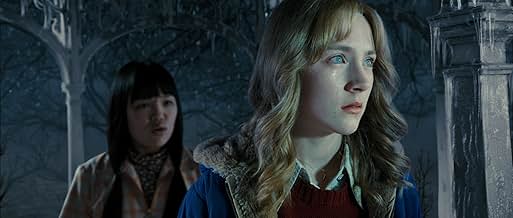
So coming back to the subject on hand, and since I did not read the novel, I can say without a pause, that the movie experience was decent enough to have had me glued to the screen from beginning to end. In her narrative, Saoirse Ronan (pronounced Ser-Sher) explains her character's tragic end and what happens after. As Susie Salmon, Ronan portrays a time in America when "do not talk to strangers" was an unheard-of caution; a time when children could roam freely and not have to live in fear of preying eyes. Sadly enough, talking to a stranger was the last thing Susie Salmon did, before being murdered, dismembered and never to be found again. But this is where her story begins, first discovering her own death, then being stranded between her overwhelming feeling of vengeance towards her murderer and watching her family suffer and tear apart during their untimely loss. It is at this juncture, or the "in-between", as she calls it, where Susie shockingly learns that she is not the first, but the most recent victim in a series of brutal murders.
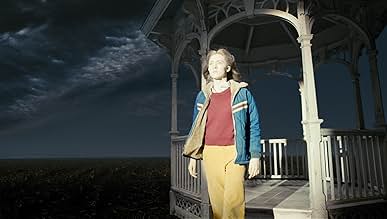
Questionable by some critics, is Jackson's use of strong visual effects in portraying Susie's transition into the "in-between". After "King Kong" and "The Lord of the Rings" trilogy, we see why Jackson is well endowed in the CGI department. That said, even having Steven Spielberg sign on as executive producer could not have influenced Jackson into telling Sebold's story in any other way but his. Visuals are crisp, abstract, and fluent while his color palette is deep yet intense with contrast, resulting in images that will push your Bluray player and HD display to the max. Is it needed in a murder mystery? Not really, because the plot is not much of a mystery; it is an innocent 14 year old girl's narration of the after-life. Again, this is where cinema CGI has the edge over raw imagination, especially when reading a book. As far as mystery is concerned, there is none. After school one day, Susie doesn't reach home because she has been lured into an underground den, specifically engineered to entice under aged girls. Her last moments are spent with her captor, a seemingly average Joe. Playing this monster is the versatile Stanley Tucci in what has to be one of his best roles thus far, deservingly earning his first Academy Award Nomination in a supporting role. Although his offering is top notch, you can't help but notice the utter darkness oozing out of his character. If the eyes are windows to the soul, then Tucci does an exceptional job as George Harvey, complete with that unmistakable flicker of evil in his eyes. Other supporting roles come from Mark Wahlberg and Rachel Weisz as Susie's parents and Susan Sarandon as her grandmother. As always, Whalberg's rage-filled scenes are intense, but very rarely are his characters helpless. For the first time here, we get to see a combination of both. Sarandon's Grandma Lynn is questionable as this character does not add to the plot, nor can her inclusion be considered a sub-plot. But if there is ever a light moment throughout the film, it does come from Grandma Lynn. Another key character is played by Rose McIver as Susie's sister and in doing so, offers some of the film's intended suspense.
This film succeeds as a drama. As a thriller, it could have been better. Comparing internet reviews between the book and the film will tell you that Jackson has chosen to leave the gory details out to get a wider audience. Although there are no actual scenes of rape, murder and mutilation, the act is heavily suggested during parts of the film and this is why it has a PG-13 rating instead of an R.
powerful and emotional
Such a powerful movie, even after watching it over, it still made me cry. It's hard to imagine such kind of beasts exists between us.
Peter Jackson has done a great job. Hats off to him.
More like this
Related interests
Saoirse Ronan Through the Years
FAQ25
Contribute to this page
Suggest an edit or add missing content