Gaming
Origami adventures to abstract e-sports, the indie scene is full of originality.
Credit: Composite game illustration by Aurich Lawson
Credit: Composite game illustration by Aurich Lawson
One of the best things about travelling to shows like PAX East and the Game Developers Conference is the chance to check out titles from off-the-beaten-path, independent developers. While shows like E3 are overwhelmed by the presence of multi-million dollar booths from huge publishers, the early-in-the-year shows make a point of highlighting some of the most original and promising game ideas from game makers without big contracts or salaried positions behind them. Freed from the financial responsibilities of the major AAA publishers, these are the titles that are most likely to truly break new ground in gameplay, aesthetics, and subject matter.
Here, we’ve collected 25 of the most entertaining indie titles we got our hands on recently. Some of these were being shown for the first time, others have been around the trade show circuit a few times now. Some are even already available for purchase or download. Regardless, all of these should at least be on the radar for anyone seeking new and entertaining gameplay experiences.
140
Developer: Jeppe Carlsen
Platforms: Windows, Mac
Available: 2013
Website
The next game from Limbo designer Jeppe Carlsen couldn’t actually be less Limbo-like. In this abstract rhythm-platform game, you control a morphing shape that rolls as a circle, jumps as a triangle, or pauses in place as a square. The appeal is in the way levels change themselves in time with the music (which hums along at the titular 140 beats per minute), featuring blocks that disappear and reappear on the beat or deadly areas of static that move in time with the harmony. As the game progresses, these syncopated, complementary beats layer on to create some devious platform puzzles along with some extremely infectious tunes.
At the end of each level, the game takes a turn for the surreal, transforming your abstract character into a spaceship or a gun-toting defender to mix up the gameplay a bit. Much like Limbo, this one is shaping up to be a short-but-sweet experience that sticks with you long after it’s done.
—Kyle Orland
Barabariball
Developer: Noah Sasso
Platforms: Windows, Mac, Linux, PS3
Available: Summer/Fall 2013
Website
If you recognize this game’s odd name, chances are you helped push the Sportsfriends Kickstarter campaign past its funding goal. Barabariball is probably the least publicized of the four games in that package, set to launch later this year, but it’s also perhaps the most deserving of the “Sportsfriends” label.
The game recalls the mid-’80s ethos of NES sports games, both in its 2D pixel art and in raw gameplay. It combines the speed and responsiveness of Nintendo’s Ice Hockey, the positional battling of Super Smash Bros., and the rules of American Gladiators‘ “Powerball” event. Teams of two jump around an arena floating on water, scoring points by throwing the ball into their own side of the water. Double-jumping and kicking dominate the mid-air ball-control battles, and as such, you’ll need to carefully manage your energy meter, which only recharges when you land. It’s a level of abstract-sports bliss you probably haven’t enjoyed since 1989.
—Sam Machkovech
Beat Buddy
Developer: Threaks
Platforms: Windows
Available: Now (Demo)
Website
What do you get when you combine an adorably blue, bouncy protagonist with a danceable beat? You get Beat Buddy, a music-based action-adventure game. Your job is to maneuver your Beat Buddy along the path, while the game integrates music in a non-linear fashion. You’ll start off with basic bass drum sounds before different elements of the background song come in gradually in layers as you progress. Eventually, Beat Buddy’s interactions with different objects and obstacles will contribute to an overall chorus of instruments.
Beat Buddy isn’t just enjoyable to play; it’s also pleasing to look at. The developers behind Beat Buddy hand-painted all of the backdrops for the game, and each of the animations move in rhythm with the sound they emit.
—Florence Ion
Cannon Brawl
Developer: Turtle Sandbox
Platforms: Windows, Xbox 360
Available: Now (alpha demo)
Website
Worms, StarCraft, and Combat collide in one of the best new action-RTS game designs in years. Two players battle on opposite sides of a 2D map, managing resources not just to build new weaponry and turrets, but also to plant bases. These bases are crucial in controlling the limited build space on Cannon Brawl‘s maps. Thanks to the simplicity of the 2D battlegrounds, strategic placement is key to staying intact.
Cannon Brawl, a PAX 10 winner in 2012, doesn’t deliver the asymmetrical genius of StarCraft. But its straightforward management of resources and object creation does a good job of distilling the intensity of a StarCraft firefight without requiring a stupidly high actions-per-minute count from combatants.
—Sam Machkovech
Cart Life
Developer: Richard Hofmeier
Platforms: Windows
Available: Now
Website
Fans of classic games like Lemonade Stand will enjoy Cart Life, a noir-style retail simulator for Windows that lets players control the lives of street vendors in an urban setting. Your mission is to complete specific goals for each playable character while using their special traits and additions. You’ll need to secure expensive permits before you can have a successful retail operation, all the while meeting the demands of your various customers.
The game features a monochromatic color scheme that suits the noir feeling well. While the storyline is a bit more open-ended than traditional simulators, players can’t veer too far off from the intended plot line. You’ll also have to keep track of minor physiological needs (like sleep) for each playable character.
The game is available free of charge, or you can pay $5 for the “Everything Edition,” or anywhere from $40 to $60 for the “Delux-o” edition. That last one includes three books and an original cartoon by the author in a collector’s tin.
—Florence Ion
Colliding Forces
Developer: Michael and Richard Leonardo
Platforms: iOS, Android
Available: Soon
Website
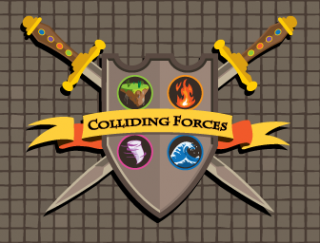
Part chess, part billiards, part Dungeons and Dragons, Colliding Forces is an intriguing two-player battle of thoughtful positioning and angles. Each player can use their limited moves in a turn to create new tokens, flick them toward an opponent’s goal, or upgrade them through a cycle of elemental abilities. Managing these abilities is key to winning. While an earth token gives you more moves each turn, a fire token can annihilate opposing forces and a wind token can set up a defensive barrier that pushes away other tokens. It’s hard to find a single dominant strategy, as each token type has its pros and cons. Players have to constantly plan ahead against possible countermoves and strategies, while also aiming their shots accurately across the iPad.
—Kyle Orland
Divekick
Developer: One True Game Studios
Platforms: Windows, PS3, Vita
Available: Summer
Website
Tired of fighting games that devolve into who’s memorized more ridiculous 14-hit juggling combos and insane sequences of finger-tangling super moves? Divekick is the game for you. This fighter distills the basic 2D fighting gameplay into just two buttons: Dive (which is actually a floaty jump into the air) and kick, which sends you hurtling down and slightly forward toward your opponent. That’s it. There isn’t even a joystick to move along the ground. Your only options are dive and kick.
The simple concept gets a little bit of depth through characters that kick at different angles or have special moves to immobilize an opponent. There’s also a backward jump-dodge, but there’s really not much to it. Making contact with a single kick is enough to win a round, and the first to five wins takes the match. Simplified down to their basic elements like this, the fights become frantic dances of positioning and reflexes that are all about feints and psychological warfare. This basic concept helped make the game the surprise hit of PAX East, with crowds ten deep yelling to get in on one of the demo units.
—Kyle Orland
Drop That Beat Like an Ugly Baby
Developer: Dejobaan Studios
Platforms: PC
Available: Now (Steam Early Access)
Website
The first thing that strikes you about this game is its extreme similarities to A Reckless Disregard for Gravity, which isn’t that surprising since both titles are from developer Dejobaan Games. Drop The Beat Like an Ugly Baby improves the concept of that first-person base jumping simulator in a number of ways. For one, the levels are now generated from MP3 files, Audiosurf-style, so the pillars and platforms you’re dodging fly by in time with the beat of the music you’re listening to. For another, the interface has been improved to show you just how close you are to the nearby objects that give you points.
The game is currently controlled with a mouse, which provides a much finer experience than the WASD controls. But the developers tell Ars that more control options may be in the final version. As long as I can plug in Tom Petty’s Free Fallin’ super-ironically, the controls can work however they want.
—Kyle Orland
Dungeon Hearts
Developer: Cube Roots
Platforms: PC, iOS
Available: Now
Website
Despite the RPG-style dressing, Dungeon Hearts is actually one of the most compelling twists on the basic match-three puzzle concept we’ve seen in a while. As four rows full of colored dots slide toward the left, you have to slide and tap to group and match collections of three dots of the same color. Tapping the gems that result from these matches not only damages the fantasy monsters in the background, but it also clears away skull tokens in the same row and column before they can damage your party of adventurers.
Pretty soon, you’re extending the simple concept to chain together gems into massive combo attacks, then using earned special powers to get around powerful enemy abilities. The action gets overwhelming pretty quickly, but the constant sub-goals and the promise of new abilities down the road keep you struggling to hold on as long as you can.
—Kyle Orland
Gone Home
Developer: The Fullbright Company
Platforms: Windows, Mac, Linux
Available: Mid-2013
Website
When Gone Home officially launches, YouTube is going to be cluttered with videos in which players squeal and worry and freak out. But that’s not really the point. While Gone Home‘s story of a missing sister and vanishing household items eventually gets pretty creepy, the game isn’t about its scares as much as its fully realized world—this is more Shenmue than Slender.
As a young woman back from college, you pick through everything in your former home, now empty, to figure out what has been happening. This is a game of exploration, not action, and thankfully, Gone Home offers plenty to discover: stories, letters, crumpled notes, postcards, memos, answering machine messages, magazines, posters, and more stories. The acting and writing throughout is top-notch—not just compared to other games, but to quality short stories—and the detail in each house trinket reflects a huge investment by the design team. This year’s GDC seemed defined by its experimental spirit, and Gone Home may very well be its best torch-bearer, combining unexpected play with captivating atmosphere.
—Sam Machkovech
Gorogoa
Developer: Jason Roberts
Platforms: Windows, Mac
Available: Now (demo)
Website
Gorogoa is to a normal point-and-click adventure game what a stained glass window is to your Kindergarten scribblings. A tale told in four highly animated panels, Gorogoa asks you to constantly layer its beautifully hand-drawn images on top of one another, creating a subtle portal for its protagonist to wander from one environment to another. The see-through outline of an apple in one panel, for instance, can be layered over the emerald eye of a dragon to become the sour green apple you’re looking to collect into your basket.
It’s all incredibly subtle, perhaps a little too subtle for its own good at this point. My playthrough of the demo was characterized by a lot of guessing and checking as creator Jason Roberts looked on and tried hard not to give me hints. He acknowledged that the game still needs tweaking to make it clearer to players what tiles can be layered and how things interact. With that last bit of polish, though, this seems poised to be a highly memorable—even moving—interactive experience.
—Kyle Orland
Hokra
Developer: Ramiro Corbetta
Platforms: Windows, Mac, Linux, PS3
Available: Summer/Fall 2013
Website
Another entry in the Sportsfriends Kickstarter, Hokra is the part of the bundle that I could most see becoming a legitimate e-sport. On a minimalist playfield, two teams of two control colored squares to collect a bouncing black ball and guide it into their goal area for long enough to fill up their meter before the other team. Carrying the ball slows you down, though, and lets the other team easily crash into you for a steal. You have to constantly pass to your teammate and bounce the ball strategically off walls to keep yourself moving at a good clip.
There’s a lot of subtle strategy to the positioning. Tapping the button to go in for a diving steal gives you a temporary speed boost, but it could also send you careening in the wrong direction if you miss. It’s like NFL Blitz without all those annoying football players and rules getting in the way.
—Kyle Orland
Kachina
Developer: Ben Esposito
Platforms: PC, Mac, iOS
Available: “When it’s done”
Website
It wasn’t until I’d burnt through a few levels in Kachina that I noticed it was pretty much the only game I’d ever seen that copies the basic pick-up-the-world mechanic of Katamari Damacy. When I mentioned this to creator Ben Esposito, he didn’t take it as an insult. Instead, he just smiled and nodded in agreement. “I know, right?”
Esposito, perhaps best known for PSN indie curio The Unfinished Swan, is already well underway with his next wacky game. In each Kachina puzzle, players control a tiny hole in the ground that grows bigger as it sucks things up: everything from debris and frogs to giant volcanoes. Sometimes, the puzzles involve sucking things up that interact while they’re in the hole, like two rabbits who, well, reproduce like rabbits once they’re down there. Other times, players have to launch items from the hole to dislodge high-up items or solve other puzzles. The game immediately felt fun and looks charming, but the demo didn’t confirm whether its one-dimensional puzzle mechanic will stay fresh over time.
—Sam Machkovech
Kentucky Route Zero
Developer: Cardboard Computer
Platforms: Windows, Mac
Available: Now (Episode 1)
Website
There’s a definite theme emerging among independent game developers lately: a well told narrative can be just as successful as hack-and-slash action. Games like Kentucky Route Zero follow in the footsteps of story-heavy games like Dear Esther and Heavy Rain. In all of these titles, unlocking the rest of the story is actually the primary goal of the game.
In Kentucky Route Zero, you play as a truck driver who works as a delivery man for an antique shop owner. When you get lost and need to find your way back out on the road, you begin to uncover a number of mysteries along the way. The game also employs some miniature text adventures to unlock some of its secrets, gradually revealing the storyline behind this cryptic environment and the intricate backstory of each non-player character.
Players can grab Act One of the game right now, and four more acts are soon to follow.
—Florence Ion
Lovers in a Dangerous Spacetime
Developer: Asteroid Base
Platforms: Windows
Available: 2013
Website
Did you ever wonder what all the little virtual crew members were doing inside that high-powered spaceship in all those space shoot-em-ups? Lovers In a Dangerous Spacetime lets you find out firsthand, but in a much more action-oriented way than games like FTL. You end up controlling your spherical, Deathstar-like space station indirectly, by running your tiny character around its labyrinthine corridors, jumping between stations that control guidance, turrets, shields and a rotating high-powered laser. The fact that you can only man one station at a time means you’re constantly trying to juggle offensive and defensive capabilities and struggling to prioritize one function over the other.
The goal is to hold off the invading hordes for as long as possible as you travel the galaxy saving helpless aliens trapped on their planets. It’s all a bit overwhelming, but it’s made manageable by the addition of a second player that can handle the shield while you’re piloting, for instance. It would be even better with a four-player mode, and the creator told Ars he’s working on one after numerous people asked. This is shaping up to be one of the most entertaining couch co-op experiences since Chip & Dale’s Rescue Rangers.
—Kyle Orland
Mushroom 11
Developer: Itay Keren
Platforms: PC
Available: Eventually
Website
No game at GDC’s Experimental Games Challenge garnered more applause from the crowd, and after going hands-on with Mushroom 11, I’d easily name it my game of GDC ’13. The game turns procedural reproduction into a key control mechanic. Clicking or tapping parts of the game’s “character,” a rigid biomass, kills some of its cells, causing the rest of the mass to regrow equally from its center point. To move the mass, you have to kill cells on one side repeatedly so that the whole mass is forced to grow in the other direction.
The game immediately gives players clever ways to play with this mechanic. Position your cells to grow in a tiny alcove, for instance, and they’ll weigh a pendulum down to make it swing around. Split the mass into equal parts, then set them to grow in opposite directions. The simple act of constant deletion feels unique and satisfying, but the puzzles send this game over the top. No wonder this Global Game Jam entry has exploded into a planned full-on retail product.
—Sam Machkovech
PWN: Combat Hacking
Developer: 82 Inc.
Platforms: iOS (coming soon to Android, PC, Mac, Linux)
Available: Now
Website
Developer Tom Asmussen isn’t shy about his elevator pitch: to make a game that plays just like the cheesy hacking sequences from ’90s cyberpunk films. PWN drips with the style you’d expect from films like Hackers and Sneakers, from neon backgrounds and phony-looking “cyberspace” settings to big-beat techno and doofy-looking avatar art.
PWN sets two hackers against each other to capture every connected node, and its levels range from simple 2D grids of boxes to intense, criss-crossing arrays that must be spun around in 3D. Tap to control a node, then use a variety of “hacks”—like firewalls, trojan horses, and viruses—to corrupt your opponent’s progress and take over. What could easily devolve into a simple tap-fest does well with a nice balance of superpowers and grid-placement strategy, not to mention a pretty decent campaign full of cheesy ’90s-film writing. It earns its $2 price on the App Store and then some.
—Sam Machkovech
Samurai Gunn
Developer: Tekno Pants / Beau Blyth
Platforms: PC, Mac
Available: Eventually
Website
Fans of couch-based competitions will enjoy Samurai Gunn’s fast-paced, 8-bit fighter action. Created by Beau Blyth of Teknopants, the game pits two to four players against each other on a 2D playfield, armed with only swords and a limited number of bullets.
Blyth, who developed the game in six months, made the core art of the game in just one night. He then took the rest of the time to polish it and add content using Game Maker 7. “I did everything except the music,” he told Ars on the GDC show floor. “I make music, but I don’t want to listen to it a million times over every time I’m testing the game.”
—Florence Ion
Scale
Developer: Steve Swink
Platforms: PC
Available: Soon
Website
The latest entry in the first-person-shooter-where-you-don’t-shoot-bullets-and-instead-solve-puzzles genre popularized by games like Portal and Antichamber, Scale‘s clever gameplay mechanic is all about controlling the size of practically every object in the world. Reducing the size of various objects gives your gun more juice, which you can use to increase the scale of other objects. You can use this power directly to expand a block below you, sending you trampolining into the air, or more subtly to, say, expand a dollhouse to human scale and explore its insides for hidden objects.
The demo shown at GDC was a lot more polished than the simple proof of concept being displayed at E3 last year, and the game seems to be at the point where it just needs a few more cleverly designed levels to become the next major sleeper indie hit.
—Kyle Orland
Starseed Pilgrim
Developer: Droqen
Platforms: Windows, Mac
Available: Now
Website
At first glance, Starseed Pilgrim looks like any traditional platformer, but once you actually get to play it, you start to realize that it’s really quite different. This open-world puzzle platformer combines the puzzle-solving mechanics of Tetris with the art-style of other well-known independent games like Fez. But it’s also so freeform that there’s no one way to solve each puzzle. “It sort of tells a really loose story,” Alexander Martin, the creator of the game, told Ars at GDC. “It tells it in poems and it’s not a linear narrative—it is bits and pieces of something and you can interpret it any way you like.”
The main premise of the game is that you’re a gardener “tending to empty noise and empty space” to help fill the void. You move around with the arrow keys and by “growing” blocks and smashing them to get to the next goal. Sometimes the goal you were reaching for turns out to be a dead end.
While Starseed Pilgrim is fun to play and beautiful to look at, it can be challenging for those who don’t like to solve puzzles. In our ten minutes with the game, we found ourselves stuck on the first level. But again, the brightly colored environment of this platformer is so addicting, you have no choice but to move forward to experience more.
—Florence Ion
Super Space____
Developer: Alexander Baard
Platforms: PC
Available: Soon
Website
The twin-stick shooter genre, which once dominated indie gaming, has gone dormant as of late. Super Space____ (pronounced “Super Space-Blank”) doesn’t seek to bring it back to life, but rather to do something entirely new with its skeleton—by breaking the movement joystick.
SS_ asks a team of shooters (preferably four) to hop on a spaceship, with each one controlling individual turrets that shoot at foes, Asteroids-style. The catch is that each turret shot moves and rotates the ship in the opposite direction, like a digital canoe stroke. It’s the only way to move the ship, and it discourages a team from all aiming and shooting in the same direction. Instead, teams must work together to keep their ship in the screen’s shifting safe zone, all the while competing with each other for individual high scores.
That competitive/cooperative balance is thrilling all by itself, but the in-development game has recently added levels that require more teamwork tricks, like shoving obstacles and finding power-ups, to give the adventure sturdier legs.
—Sam Machkovech
Tengami
Developer: Nyamyam
Platforms: Windows, Mac, iOS
Available: Summer 2013
Website
After offering a demo of the iPad game Tengami, co-creator Jennifer Schneidereit asked a surprisingly welcome question: “Are you ready to be patient?” Absolutely, I said to myself, already worn down by an endless run of panels and demos at GDC.
It was a perfect leading question, as Tengami exudes a calm, cool feeling through its every element. Its traditional Japanese music, watercolor scenery, and slow pace might test antsier players’ patience, but the world is too beautifully crafted to charge through, anyway. Players proceed by guiding a samurai character through papercraft worlds, which repeatedly fold open and closed to reveal new paths. (The game’s Japanese name is fitting, with “ten” meaning “toward heaven” and “gami” describing paper.)
Tengami‘s brief demo only had a few puzzles, which revolved around tapping glowing targets on the iPad screen to fold the surrounding world, but the polish and aesthetic already felt complete. Schneidereit and her design partner Phil Tossell left Rare a few years back after finishing Kinect Sports, and from the look of this, their first project afterward, we’re thankful they did.
—Sam Machkovech
Tenya Wanya Teens
Developer: Uvula
Platforms: N/A
Available: N/A
Katamari Damacy creator Keita Takahashi was on hand at GDC to show off his latest experimental game concept. The game is cute but decidedly conservative. Two players merely walk around in a giant 2D plane to interact with teenage crises using simple verbs: Flirt! Study! Shower! Whoever walks up to a crisis and solves it first gets those points.
Oh, but have you seen this game’s controller? Holy cow. It’s a giant joystick contraption with 16 buttons—eat your heart out, Atari Jaguar. More impressively, each button is backlit to glow different colors at any given time. As the game goes on and new verbs are introduced on-screen, new button colors appear on the controller. By the end of a session, players have to juggle more than a dozen actions, and they’ll need to memorize all the associated colors to beat opponents, even as they move about the controller. The end result is the best two-player expansion of the Simon concept ever made.
—Sam Machkovech
TowerFall
Developer: Matt Makes Games
Platforms: PC
Available: Soon
Website
At no point did the games TowerFall and Samurai Gunn stand side-by-side at GDC, and perhaps that’s for the best. Both games revolve around single-screen, 8-bit, 4-player, 2-dimensional insta-death combat, and you could imagine the games’ creators getting into a chicken-and-egg shouting match in the wrong scenario.
Yet there’s plenty of nuance in the old-school deathmatch genre, as shown in the subtle differences between the games. In TowerFall‘s case, that comes from bow-and-arrow combat with a weird tweak. Namely, arrows will change their trajectory thanks to a mild heat-seeking mechanic, meaning players can’t survive by just holing up in cover. Players must also constantly keep their ammo stocked by moving to reclaim arrows, bombs, and other useful items from walls and corpses, or take them directly from foes. Fast, snappy, and full of gotcha moments and clever arenas, TowerFall is the Gauntlet to Samurai Gunn‘s Bushido Blade, the Power Stone to SG‘s Smash Bros. If you love one, you’ll love the other.
—Sam Machkovech
Transistor
Developer: Supergiant Games
Platforms: Undecided
Available: 2014
Website
For its follow-up to the critically acclaimed Bastion, Supergiant games is revisiting the action-adventure genre from an isometric overhead view. Instead of a faceless narrator guiding the action this time, though, the voice-over is now provided by a dead guy whose soul has been trapped inside a massive sword called the Transistor. You control a famous singer known only as Red, who carries the Transistor and works with it to take out the robotic presence of the Process that has overrun the city, absorbing more souls from the dead to gain new powers as she does.
You can play Transistor like a pure action game, but it seems better designed for turn-based strategy, where you get to pause the action and plan just how you’ll use your limited actions to best position yourself to do maximum damage, then dodge the Process’ counterattacks in real time while your action meter refills. It’s a great mix of reflex and strategy, merged with some top-notch neo-dystopian art, great evocative voice acting, and beautiful original music. It makes for an immediately entrancing experience.
—Kyle Orland
Listing image: Composite game illustration by Aurich Lawson

Kyle Orland has been the Senior Gaming Editor at Ars Technica since 2012, writing primarily about the business, tech, and culture behind video games. He has journalism and computer science degrees from University of Maryland. He once wrote a whole book about Minesweeper.