Science
We sit down with the guy who trains spacewalkers to see what’s right—and wrong.
Credit: Warner Bros.
I haven’t seen Alfonso Cuarón’s Gravity yet, but I want to. The movie will enter general release here in the US on October 4. It stars George Clooney and Sandra Bullock as two astronauts having what looks to be a really, really bad day in space. Trailers for the movie show them flying around in their space suits, yelling and crying and dodging debris from exploding satellites and space ships and space stations, all lit by a beautifully rendered and untouchably distant Earth in the background.
The director and the studio have taken great pains to recreate the experience of operating in microgravity as accurately as possible. Cuarón consulted with NASA astronauts on the particulars of moving in microgravity, and, according to the NY Daily News, the movie’s production designers studied thousands of NASA photographs in order to make their vision of space look authentic.
When asked how far that commitment to verisimilitude stretched, though, Cuarón said that while the movie strives for accuracy, “it would be disingenuous to say we did it 100 percent, because this is a movie, and we needed to take certain liberties.”
The five minute-plus extended trailer for Gravity. Keep this video handy, because we’re going to give it the MST3k treatment in just a moment.
There was a five-minute “extended trailer” for the movie published last month. It certainly had some gripping visuals, but the longer it went on, the deeper my frown became. I don’t claim to be an expert, but the stuff that George Clooney and Sandra Bullock were doing on the screen just didn’t look right. Certainly cool, but not right.
But this is Ars, and on certain things, we have the hook up. I may not be the expert, but I knew someone who was, and I was going to ask for his official opinion on that extended trailer.
The man who makes the plan
The last time I talked with Zeb Scoville was at NASA’s Neutral Buoyancy Lab, the enormous indoor pool where NASA trains its astronauts on how to spacewalk—or, more properly, how to function during extravehicular activity, or EVA. Scoville is the EVA task group lead at the NBL, and he is responsible for managing the teams that figure out how EVAs work. If an EVA’s goal is to replace a part outside the space station, for example, Scoville figures out exactly what the astronauts need to do to replace the part, including the physical movements they need to make. His team is made up of actual NASA flight controllers—during training at the pool, they run the simulations, and during the actual missions, they’re manning the consoles in Mission Control.
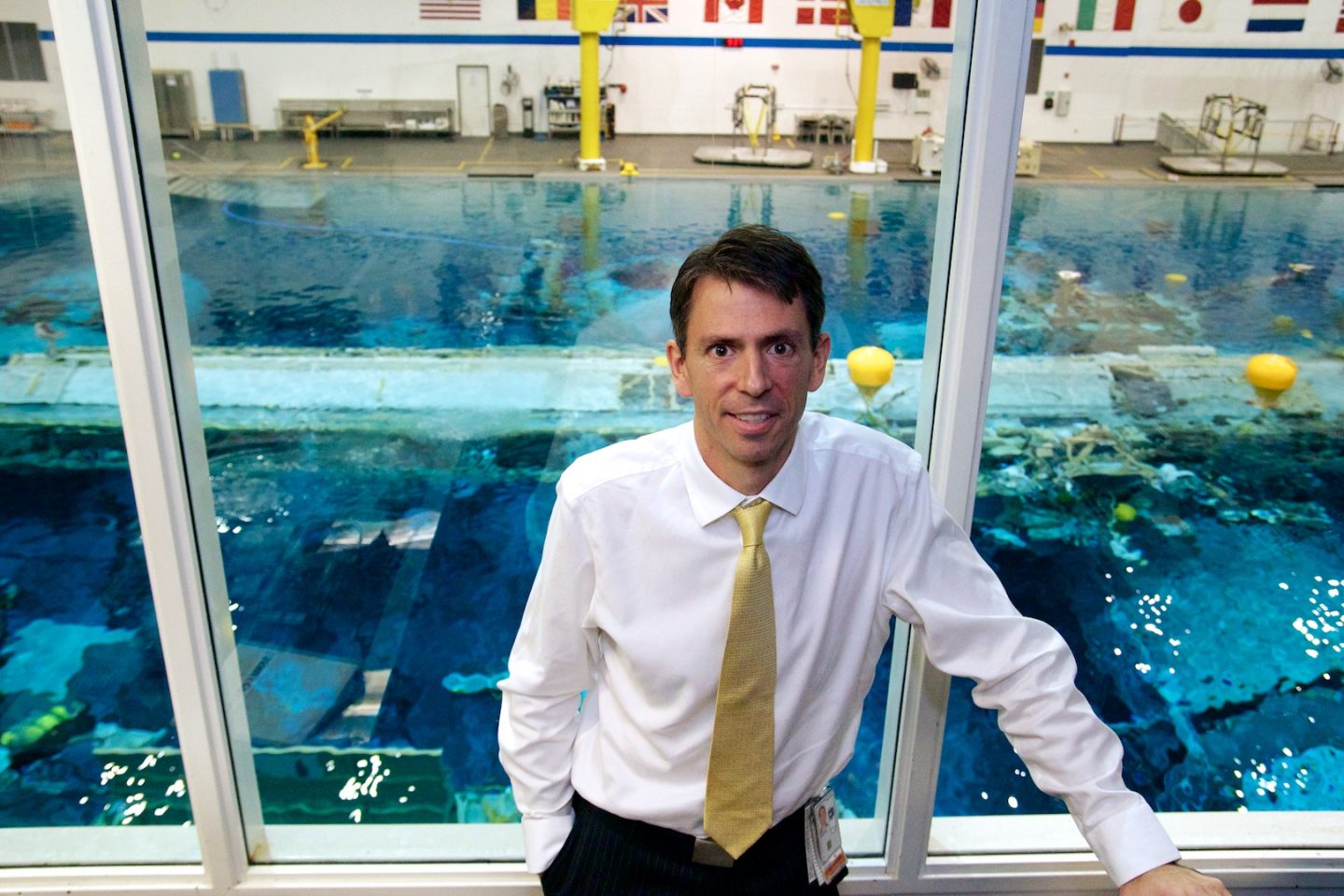
NASA EVA Task Group manager Zeb Scoville, standing in one of the test coordinator control rooms at the Neutral Buoyancy Laboratory. Visible behind him is the NBL pool.
Credit: Steven Michael
NASA EVA Task Group manager Zeb Scoville, standing in one of the test coordinator control rooms at the Neutral Buoyancy Laboratory. Visible behind him is the NBL pool. Credit: Steven Michael
If anyone could shed some light on the accuracy or inaccuracy of Clooney and Bullock’s space antics, I figured Scoville would be the man. After a quick call to NASA’s press office to arrange some time to talk, we sat down together to watch our way through the trailer.
Problem: debris
The trailer kicks off with an EVA in progress, and a radio-distorted voice is heard calling for an abort. It becomes clear that the message is directed at some astronauts working on something outside their spacecraft. It looks like they’re repairing the Hubble Space Telescope, though it might be something else—for instance, some KEYHOLE reconnaissance satellites are said to share the Hubble’s external form factor. Whatever it is, the astronauts are outside with big debris incoming, which means they’re in trouble.
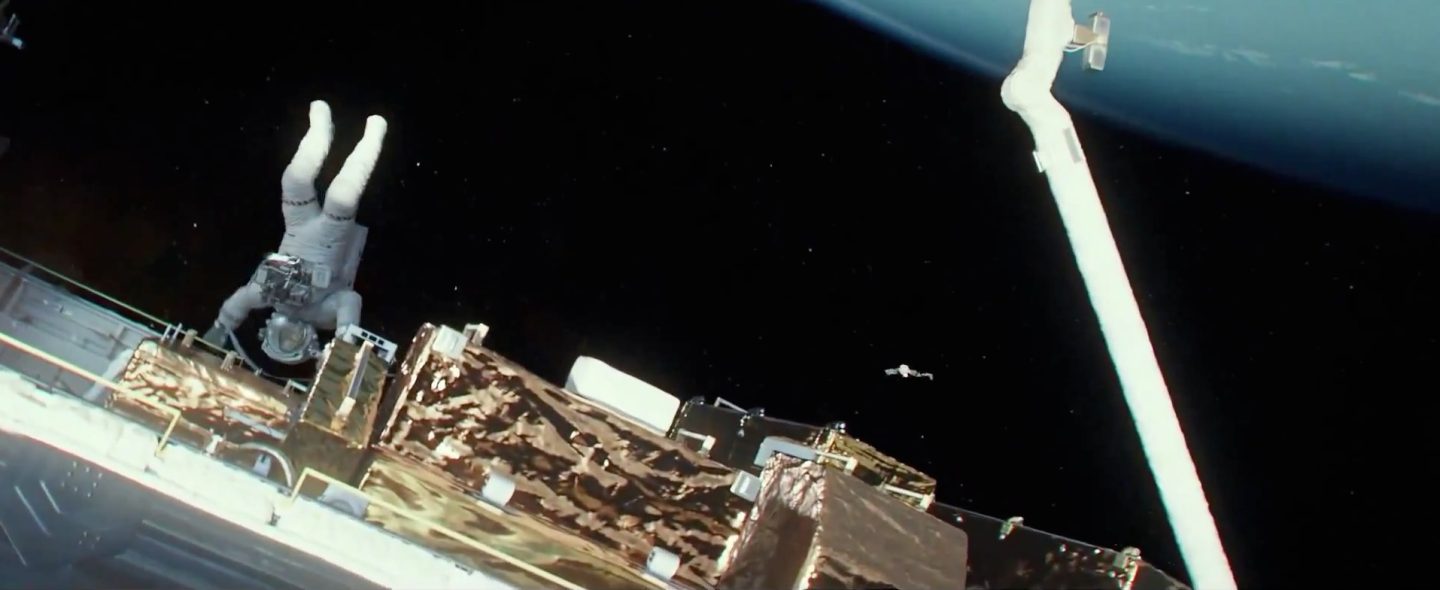
Screencap from the trailer, showing the start of a giant debris storm. Note the monstrous size of the piece of debris near frame center.
Credit: Warner Bros
Screencap from the trailer, showing the start of a giant debris storm. Note the monstrous size of the piece of debris near frame center. Credit: Warner Bros
Right away, the sheer size of the debris gave us pause. NASA relies on US Strategic Command’s big radars to keep constant radar watch on its vehicles, and the chunks shown on-screen are far larger than the minimum size that USSTRATCOM would notice. “Part of the procedure for getting ready for an EVA would include checking for debris like this, wouldn’t it?” I asked.
“Right—we have a process that’s known as a ‘certification of EVA readiness,’” answered Scoville. “We have the EVA community come together, and they’ll present a lot of the technical analysis, and we give our community-wide consensus for a ‘go’ for the EVA.” Scoville explained that this analysis includes an assessment of the risk of encountering orbital debris during the EVA. Space isn’t empty, especially at the International Space Station’s low altitude, and there’s always the chance that there’ll be a “conjunction,” NASA-speak for a potential collision between debris and a vehicle or astronaut. Debris risk is assessed in terms of the potential damage—whether the expected amount of debris could cause a suit leak small enough to survive (which would terminate the mission), or whether it could cause loss of a spacecraft or even astronaut lives.
“The debris they have there is orders of magnitude larger than what you need to create a very catastrophic puncture in a space suit. For comparison, if you have up to about an eighth inch of a hole in an EMU”—that’s Extravehicular Mobility Unit, NASA’s acronym for a spacesuit—“it has emergency oxygen systems which can feed that leak and maintain pressure for about 30 minutes to get you back inside the airlock and repress the airlock. Above about an eighth of an inch, and it can’t maintain pressure.”
“Is there a procedure for what to do if that happens?” I asked. “Like, you stick your finger in the hole or try to squeeze the leak closed?”
Scoville responded in the negative because of the spacesuit’s many-layered structure. “On the inside, you have the bladder layer, that actually maintains the pressure of the suit. Beyond that there’s the restraint layer, and then you have a neoprene layer, and beyond that the insulation mylar layers for heat rejection, with layers of scrim in between for separation, then the white Ortho-Fabric on the outside. No matter how much you squeeze or push on the outer layer, you’re not getting to the inner layer where the bladder is. You wouldn’t be able to seal that with a gloved hand with 4.3 pounds of pressure trying to get out of the suit.”
Although an EVA wouldn’t be allowed to happen under such conditions, Scoville speaks up here and lets me know that he’s actually Googled a plot summary of the movie in preparation for our talk. The debris in Gravity actually comes from an event that occurs after the EVA has started. Under such circumstances, the EVA would indeed be terminated, just as is depicted in the trailer. I stow my nerd rage, and we continue.
Problem: Clooney’s jetpack
After the debris zips past, intrepid astronaut George “The Chin” Clooney comes in frame, sporting a very cool space jetpack. There’s a problem with that backpack, though—nothing like it exists in NASA’s active inventory anymore. To me, it looks like Clooney’s character is supposed to be wearing a Manned Maneuvering Unit or MMU, a piece of equipment developed for shuttle astronauts to use while repairing satellites. The MMUs worked great, but they weren’t used very much, and NASA discontinued flying them in the 1990s. They weren’t re-introduced for use on the International Space Station because they’re too large and bulky.
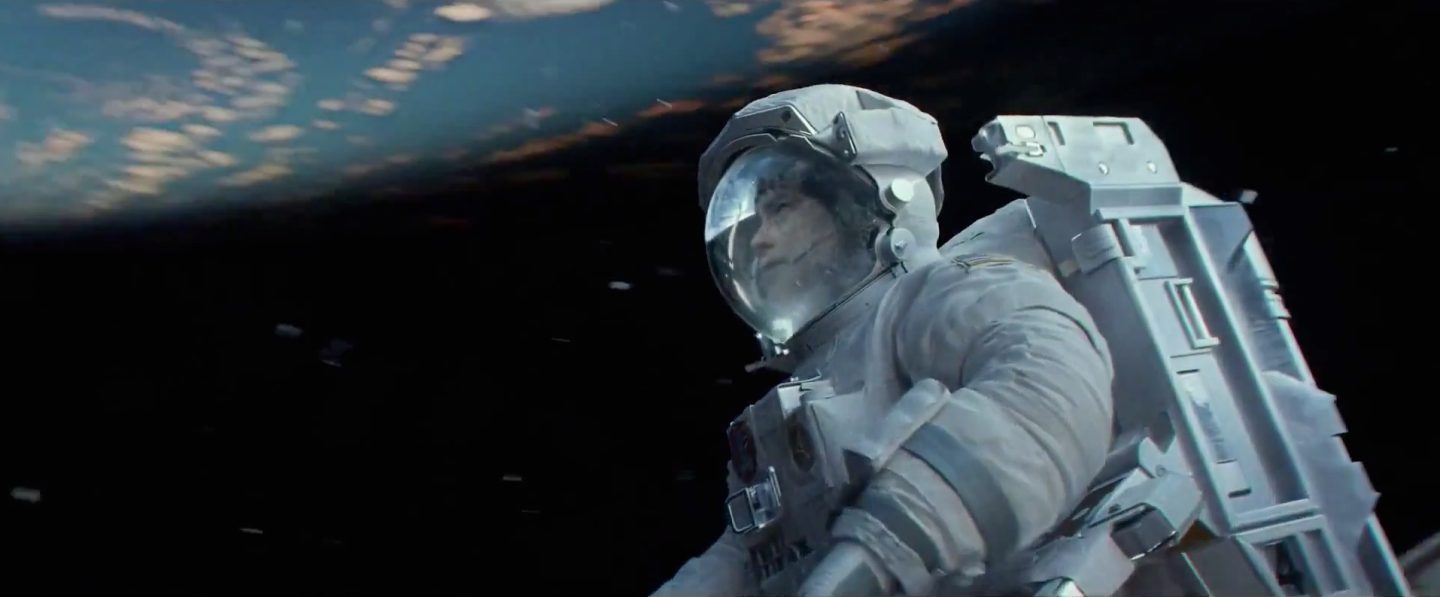
Clooney’s fancy faux-MMU backpack sure does zip him around quick. Unfortunately, it’s a wholly fictional piece of hardware.
Credit: Warner Bros.
Clooney’s fancy faux-MMU backpack sure does zip him around quick. Unfortunately, it’s a wholly fictional piece of hardware. Credit: Warner Bros.
I point this out to Scoville. “Yeah,” he replied. “It looks not quite like a MMU, but it’s something close to it. Those things, the manned maneuvering units, are no longer used. In some of those shots, it looks like a cross between a MMU and a thing we call SAFER, which stands for ‘Simplified Aid for EVA Rescue,’ which is similar to a MMU—except it doesn’t have the same level of redundancy, it’s not as large, the joystick is a little different, and it doesn’t hold as much gas.”

The SAFER backpack—the closest operational real-world analog to the thing Clooney is wearing.
The SAFER backpack—the closest operational real-world analog to the thing Clooney is wearing. Credit: Wikimedia Commons
The SAFER backpacks are for astronauts working around the International Space Station, and as the acronym suggests, they’re intended to be used in case an astronaut accidentally drifts away from the station. Scoville explains that the little safety jetpack has 24 thrusters powered by the venting of compressed nitrogen gas, and it can accelerate an astronaut up to about 10 feet per second. The SAFER also has a smart gyro-based stabilization system that will automatically stop an astronaut from tumbling. However, these packs aren’t intended to be used as the primary means for flitting about outside. The limited amount of delta-v the backpacks can impart is more than enough to stop a drifting astronaut, but the amount of propellant is very limited.
SAFER backpacks weren’t used on shuttle missions, either: “On shuttle missions, when they weren’t docked to station, they didn’t need this—they could just fly the shuttle after them to pick them up if they fell off.” This provides one explanation for why Clooney’s character is wearing a jetpack and Bullock’s character isn’t—when we meet her in a moment, she’s strapped into the foot restraints at the end of the space shuttle’s remote manipulator arm, busily working away at repairing the telescope.
Problem: Clooney’s Superman impersonation
We hit play again, and George Clooney expertly zips across the screen like a space-suited Man of Steel. Bullock’s character requests help being moved off the end of the SSRMS arm. Clooney smartly orients himself, nulls his rotational rates, and shoots off toward where Bullock is hanging out in space.
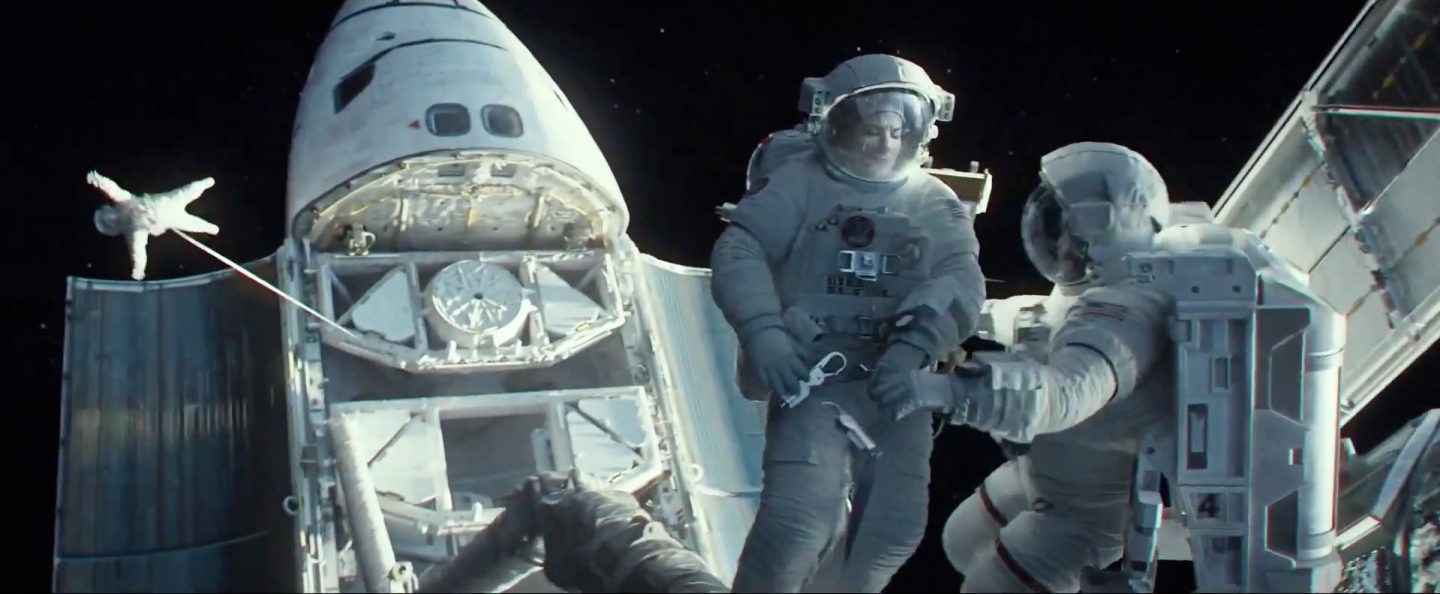
Clooney assists Bullock, while in the background another hapless astronaut is hit by debris.
Credit: Warner Bros.
Clooney assists Bullock, while in the background another hapless astronaut is hit by debris. Credit: Warner Bros.
“Very Superman,” laughed Scoville. “You could do that about once, before you blow all your propellant. Very, very expensive propellant-wise to have high acceleration and quick changes in speed and direction.” Scoville informed me that when training astronauts for EVA, especially when working on the SAFER backpacks, they have a saying: “If you feel like you’re moving at a snail’s pace, you’re doing it right.”
“There’s also a lot of nonintuitive things that come into play with orbital dynamics,” he continued. “Like, with how you fly, relative to a vehicle in low Earth orbit. It’s not necessarily a point-and-shoot type thing. Orbital dynamics affect the trajectory, and so you really just want to do a couple of small pulses and then see what direction it takes you in. For the big ‘lay on the gas’ moves and the tumbling—well, technically feasible, but you’d run right out of prop.”
Problem: Clooney’s rescue attempt
Clooney’s zippy-quick journey up to rescue Bullock brought us to another problem—beyond his irresponsible and implausible use of his propellant stores, would he actually be able to get Bullock’s character back into the safety of the shuttle’s cargo bay faster than the SSRMS arm could simply lower her?
Credit where credit is due, though. As we watch the scene, Scoville speaks up. “They’ve got Sandra Bullock in foot restrains on the end of the robotic arm—we have the same foot restraint, and there’s a tool stanchion they show behind her, and that’s right out of the Hubble repair book!”
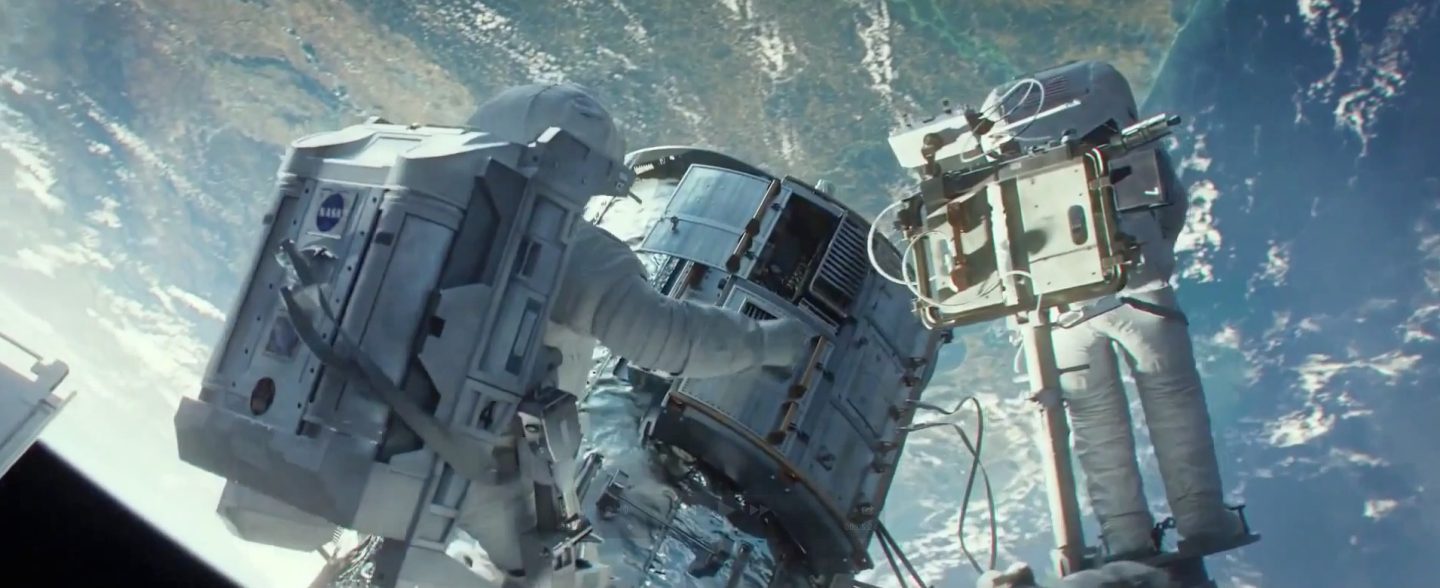
Sandra Bullock’s character is poised on the end of the Space Shuttle Remote Manipulator System arm, standing in front of a tool stanchion that Scoville calls “right out of the Hubble repair book.”
Credit: Warner Bros.
Sandra Bullock’s character is poised on the end of the Space Shuttle Remote Manipulator System arm, standing in front of a tool stanchion that Scoville calls “right out of the Hubble repair book.” Credit: Warner Bros.
Before I can ask about Clooney detaching Bullock and lowering her down, Scoville continues: “So, let’s say that there was more time—like, the arm was stuck out there” without the threat of hypervelocity debris impacts. “She could get out of the foot restraints and just climb back down the arm. But, could someone fly out there like this and pick her up and fly her back?” He hesitates. “Well, maybe.”
The problem turns out to be one of mass and inertia. On the brief jaunt out to the end of the arm, Clooney’s pseudo-MMU only needs to accelerate his suited mass; if he’s able to unhook Bullock, her own suited mass adds considerably to the amount the backpack’s thrusters must accelerate (and that’s putting aside questions of how much propellant remains in the tanks).
On top of that, there’s something else that matters more than simply the amount of mass: the positioning and center of that mass. “The positions of the jet on those thruster towers have to be on the center of mass on him, otherwise—like, if he’s holding onto her, and their combined center of mass is somewhere else, his ability to control and maneuver may be unstable, and he won’t be able to help.” The only way to work around that problem would be to do the rescue very, very cautiously. “It would be something very slow, very not-rushed,” Scoville said. “It would just be faster for her to climb down the arm.”
I observed that in this situation, with the arm mobile and with debris incoming, it would be faster to simply retract the arm than to have Clooney go and rescue Bullock. Scoville agreed: “Right—faster to just fly the arm back.”
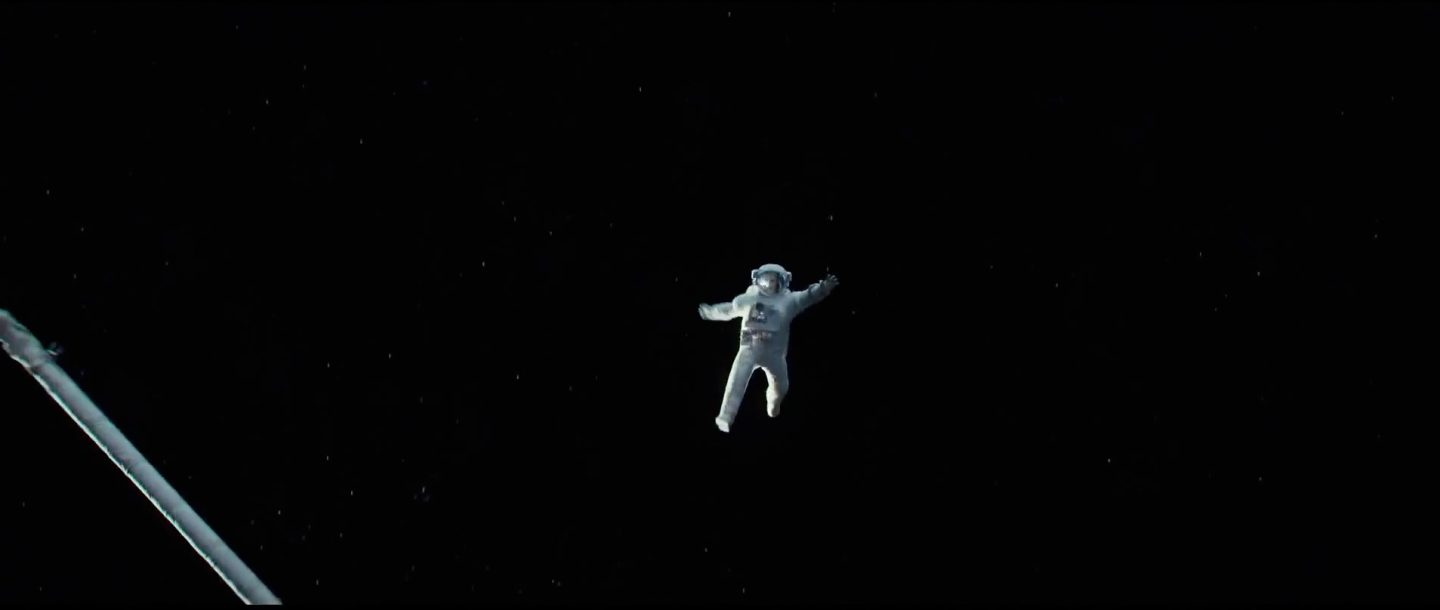
Bullock’s character is having a bad day in space.
Credit: Warner Bros.
Bullock’s character is having a bad day in space. Credit: Warner Bros.
The BIIIIIIG problem: From HST to ISS
All the issues with microgravity maneuvering aside, there’s one ludicrously ginormous problem that stuck out the very first time I saw the trailer, and I couldn’t wait to bring it up. Unfortunately, Scoville beat me to it. (Understandable, since he’s an actual rocket scientist kind of guy.)
“You’re going to ask about how they go from the Hubble to the ISS, aren’t you?” he said as I opened my mouth to ask that very question.
“Yeah,” I replied, grinning. “So, I looked up the ISS orbit, and I looked up the Hubble Space Telescope orbit, and they’re wildly different. Now I’m no orbital mechanics expert…”
“Just shut up and eat your popcorn,” Scoville interrupted, laughing.
I laughed back, and he continued. “You’re right. There’s…you couldn’t…the space shuttle couldn’t go from Hubble to ISS. When we did the last Hubble servicing mission, we were concerned about what to do if there was tile damage—could we fly to the ISS? The answer was no, never. The shuttle didn’t have enough propellant to be able to fly from Hubble to ISS. The plane changes there are monstrously expensive.”
Those of you who are experts in orbital mechanics—or perhaps regular Kerbal Space Program players—are likely nodding your heads in agreement, but this bit of jargon requires some explanation for the rest of us.
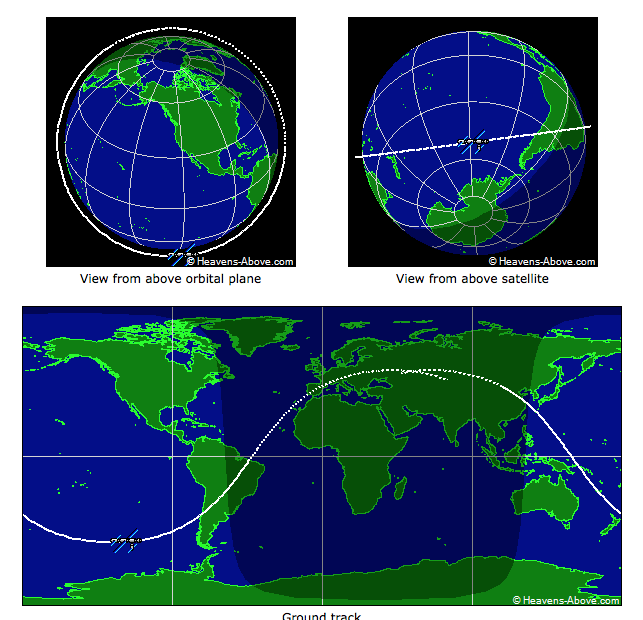
Graphical representation of the International Space Station’s orbit.
Graphical representation of the International Space Station’s orbit. Credit: Heavens Above
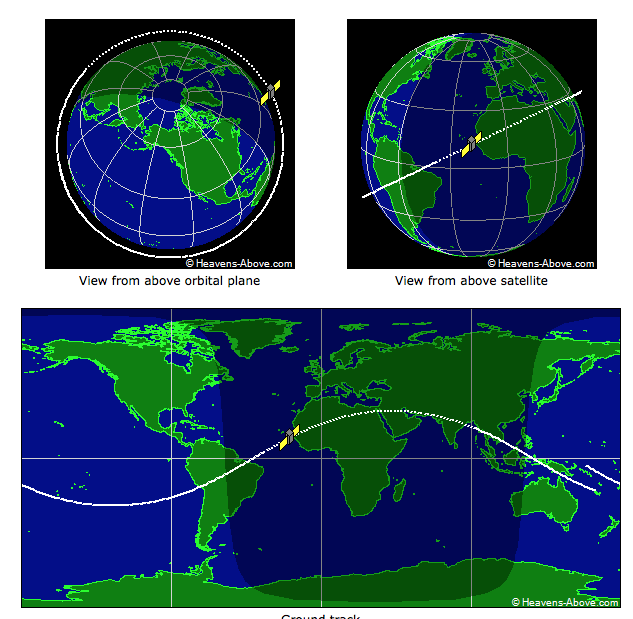
Graphical representation of the Hubble Space Telescope’s orbit. Credit: Heavens Above
The two images above depict the orbits of the International Space Station (top) and the Hubble Space Telescope (bottom). The ISS orbits at a ground height of a bit over 400 kilometers (nearly 250 miles). Specifically, it’s in a not-quite-circular orbit whose apogee (farthest distance from the Earth) is 417km and whose perigee (closest distance to Earth) is 413km. The ISS has an orbital inclination of about 51.65 degrees, which means that its path takes it at a 51.65-degree angle relative to the Earth’s equator as it flies. By contrast, the Hubble Space Telescope flies farther out and lower in the sky relative to the equator—557km apogee (nearly 350 miles), 552km perigee, and an inclination of 28.47 degrees.
So they’re in different parts of the sky, but why is that problematic? Orbital mechanics is a powerfully counterintuitive field. Even if it’s difficult to see why just from glancing at the orbits on a globe, the amount of energy it takes to change from an ISS-like orbit to an HST-like orbit is pretty staggering.
The first way you need to spend energy is to change altitude—in this case, to lower the orbit by about 140km (nearly 87 miles). Changing an orbit means burning propellant at both your apogee and perigee—first with a retrograde burn (a burn against your direction of travel) to start the process of lowering your altitude and then a second retrograde burn on the other side of your orbit to circularize your orbit. Then comes the counterintuitive part: in spite of the retrograde burns, by lowering your orbit you’ve actually gained velocity.
But changing your altitude is relatively simple stuff. The real energy sink is the shift from the HST’s 28.47-degree orbital inclination to the ISS’s 51.65 degrees—that’s the “plane change” Scoville mentioned.
Look at the images of the two orbits above. To conduct a plane change maneuver and change your orbital inclination, you have to apply some amount of acceleration perpendicular to your current direction of travel. The vagaries of physics dictate that the amount of acceleration required is a significant percentage of your existing orbital velocity. In fact, large plane changes require more acceleration than was required to accelerate the spacecraft to orbital velocity in the first place. NASA designs its missions to include as few plane change maneuvers as possible. It’s often worth spending extra energy at launch to get a spacecraft into a desired orbital plane to start with, rather than launching and then adjusting later.
When plane changes are required, they’re done as conservatively as possible. Because orbital velocity (counterintuitively) decreases with height, it’s often less energy-intensive to first translate up to a higher (and therefore slower) orbit and plane change up there where the required amount of energy is lower. The percentage required is the same, but you’re traveling slower, so the actual amount of delta-v that must be applied is lower. Then, after the plane change has been done, you translate back to a lower (faster) orbit. This complex up-and-down maneuvering can actually save energy over simply plane-changing directly. (If you want to dig deep into the math behind how and why orbital mechanics work this way, there are some equations and a relatively simple set of explanations on this page.)
All this being said: is it even remotely possible that George Clooney and Sandra Bullock, with only a single pseudo-MMU between the two of them, could lower their orbit and change planes away from the Hubble to meet up with the ISS?
No. Not a chance in hell. Can’t happen. Utterly impossible.
“Just…just forget it and eat your popcorn,” Scoville suggested.
Problem: Suit abuse
Leaving the craziness of orbital mechanics behind, we press on. Clooney and Bullock magically make it to the ISS, but they’re out of propellant. They apparently aim themselves at the station and attempt to manually arrest their velocity by grabbing at the ISS—with their hands.
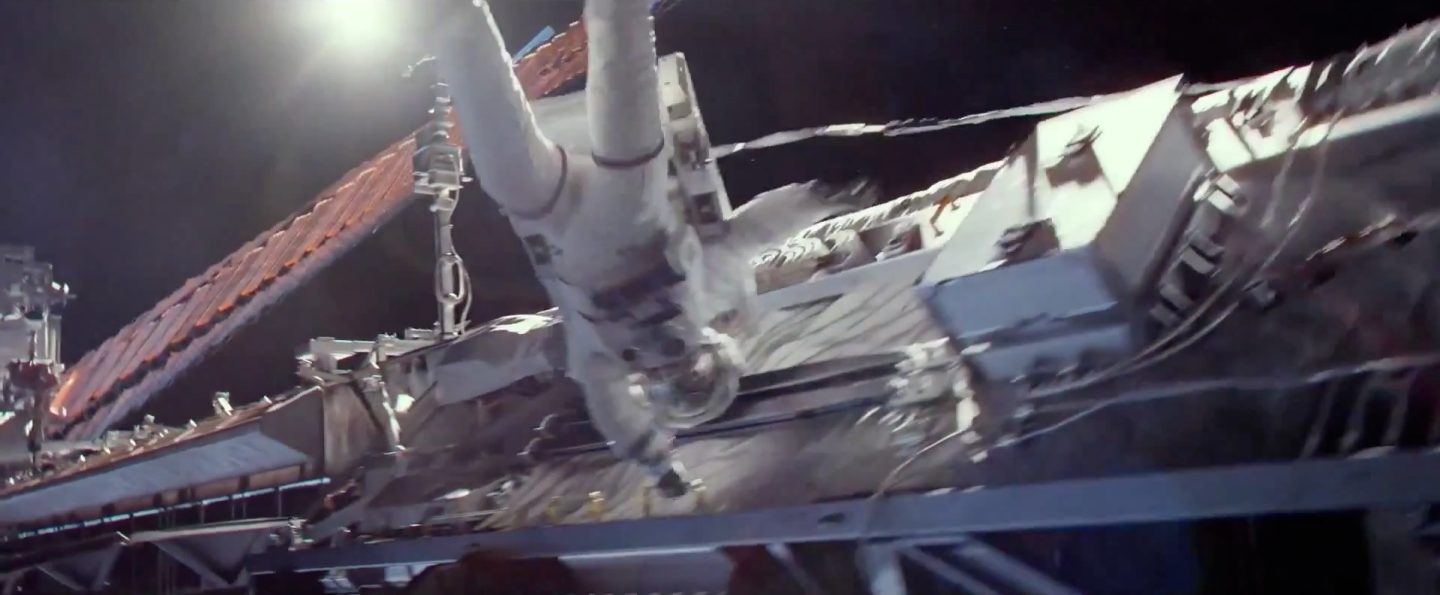
Clooney sticks the landing! The Romanian judge awards him a 9.5!
Credit: Warner Bros.
Clooney sticks the landing! The Romanian judge awards him a 9.5! Credit: Warner Bros.
At about 3:25 in the video, Clooney masterfully sticks a hand-hold and stops himself. This seemed implausible to me—after all, on top of Clooney’s own mass, the EMU weighs more than a hundred pounds. Then there’s the weight of his faux-MMU. Could he really grab and hold that much mass, or would he just pull his shoulder out of socket?
“What hurts me the most about that shot—and it’s a cool shot!—is less his ability to grab the handrail and more the impact that happens on his life support backpack and his visor,” commented Scoville. “I mean, he swings around and his visor goes SMASH into that metal structure, which, I mean, would probably have shattered his visor. There’s a lot of severe impact to the suit that it just wouldn’t be able to take.”
I hadn’t noticed, because I’d been watching Clooney grab for the rail. But we replayed the scene, and sure enough, Clooney thuds right into the ISS truss and smashes his helmet after he grabs the rail. “Would his hand be able to grab like that?” continued Scoville as we watched. “Sure. You can get a pretty good grip on those rails—they’re sort of designed to be the perfect size to get a good grip on. You probably wouldn’t have your shoulder coming out of socket in this case—there’s lots of axial restraints in the suit fabric, and a lot of load would be transferred along the suit itself.”
This sounded a lot more preferable to having your shoulder wrenched, but then Scoville finished: “So, the suit arm might get ripped off, probably before your shoulder would.”
“In the grand scheme of things, that actually sounds like the worse of the two options,” I opined. A wrenched shoulder would almost certainly be preferable to, say, being subject to near-immediate decompression as your suit’s arm is torn away.
He laughed again. “Yeah, right! But to grab with your hands, it wouldn’t be any harder than if you were falling at that speed. They look like they’re moving maybe, five or eight feet per second.”
What the Gravity trailer gets oh so right
We joked about the realism issues with the trailer, but quibbles aside, Scoville had nothing but high praise for the look and feel of things on-screen. “They’ve done a fantastic job trying to represent the shuttle and the vehicle themselves. There’s some liberty with some details of some of the minor things, but that’s minuscule—I think they’ve maintained the believability of the hardware they show.”
The dynamics of motion are also represented: “They obviously put some work into that as well. You’ve got scenes where they’re tethered together as they’re floating, and they have accurate two-body tethered motion. I mean, everything is moving so fast it’s hard to get in and really analyze it, but they obviously put a lot of thought into it,” Scoville said. “It’s tough to find too much that looks off about how things move around.”
A parting problem: an agency-destroying problem
After we’d gone back and forth through the trailer a few times, a thought struck me. I mentioned that I have friends and family still working in aerospace, many of whom are directly involved with the ISS. Their inevitable reaction to seeing the Gravity trailer hasn’t been “Oh, man, look at that!” but rather, “Oh, man, if that happened it would kick off so many meetings, and I’d have so much paperwork.”

This is the absolute God’s honest truth.
This is the absolute God’s honest truth.
Scoville laughed as I related the story, but it made for an interesting question: if something this dramatic happened—and the trailer ends with the ISS apparently exploding, so that’s about as dramatic as it can get—what would the potential fallout be?
Scoville paused before offering his own perspective on the NASA bureaucracy and the way an incident of this magnitude might unfold. “You know, I don’t think we’d be in many meetings or doing much paperwork,” he said. “I don’t think there’d be much of a NASA left.”
He continued: “This summer, we went through a pretty significant mishap on one of our EVAs; we had a case where an astronaut’s cooling water leaked into his helmet, and he actually came pretty close to drowning.” The incident Scoville referred to happened in mid-July to astronaut Luca Parmitano. Fortunately, quick action got him safely recovered into the station airlock and everything turned out OK. Still, even that anomaly has been enough to kick off months of investigations, meetings, and a complex root cause analysis. “The effort that’s going on now to understand that and regain confidence in the hardware and the suit and understand what the root cause was is very much taking up our entire focus now, and it probably will be the main concentration of the work with EVA for the coming year,” he said.
“So that’s just with one suit,” I interjected. “Here, you’d be talking about the loss of hundreds of billions of dollars of assets, and potentially lives, too.”
“Meetings would become irrelevant at that point,” he replied. “It would be more like, do we as a species want to continue to fly into space, and make it a priority to rebuild that capability.”
This last bit painted an issue potentially even larger than the orbital transfer problem. I’m still anxious to see the film, but Scoville’s comments make me wonder if there’ll be room for a sequel (maybe next year, we’ll be eagerly anticipating the upcoming blockbuster Gravity 2: The Congressional Inquiry).
I’m sure Gravity will be a fine movie, though, and it’s easy to forgive the liberties it takes to tell a dramatic story, especially in light of the tremendous and obvious effort to get so many of the little details about manned space flight so right. If they have to give George Clooney a made-up backpack that lets him fly with Sandra Bullock from the Hubble to the ISS—well, so what? It looks cool, and it plays well on-screen. Or, to put it even more succinctly—in old western movies, no one ever shoots the horses out from under the charging mob of bandits to quickly end the fight and save the day. Why? Because if they shot the horses, there’d be no movie.

Lee is the Senior Technology Editor, and oversees story development for the gadget, culture, IT, and video sections of Ars Technica. A long-time member of the Ars OpenForum with an extensive background in enterprise storage and security, he lives in Houston.