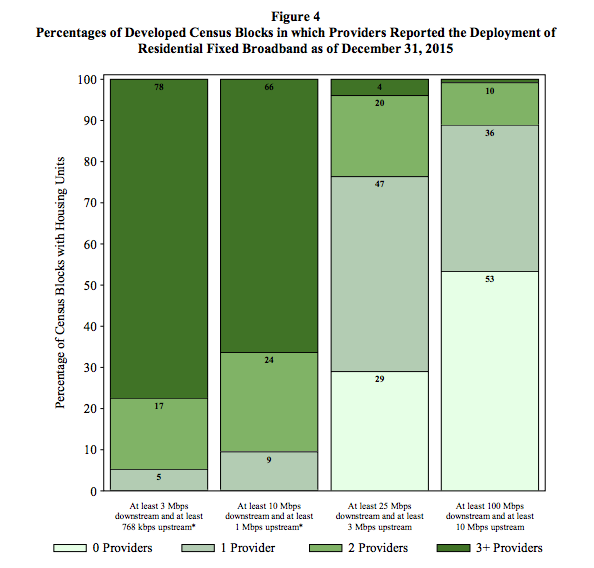
The report provides the latest numbers on how much competition exists for various speeds in each developed census block. Just as in previous reports, customers don’t have much, or any, choice of providers offering high speeds. Only 24 percent of developed census blocks had at least two ISPs offering broadband at the standard of 25Mbps downstream and 3Mbps upstream. There were zero such providers in 29 percent of the census blocks:
Many homes don’t have fixed Internet service, whether it’s because the residents can’t afford it, don’t want it, can’t buy it due to lack of availability, or make do with mobile Internet. Residential fixed connections are up to 93 million, after more than doubling since 2005, but there were still just 72 residential fixed Internet connections for every 100 US households. The data on fixed Internet connections includes DSL, cable, fiber, satellite, fixed wireless, and even rare connection types such as broadband over power lines.
DSL and satellite connections struggle
Separately, the FCC last week also released its latest Measuring Broadband America report, which compares advertised speeds to actual speeds by testing in the homes of more than 4,000 Internet subscribers. The median download speed for US consumers was measured at 39Mbps, up from 32Mbps the previous year.
One of the key statistics from this report “is the 80/80 speed consistency which is the speed that at least 80 percent of the subscribers experience at least 80 percent of the time over peak periods,” the FCC said. “Optimum [formerly Cablevision], Charter, Time Warner Cable and Verizon (FiOS) did well with values rising above 90 percent of the advertised speed. This ratio fell below 50 percent for AT&T (DSL), Frontier (fiber) and Viasat (satellite).”
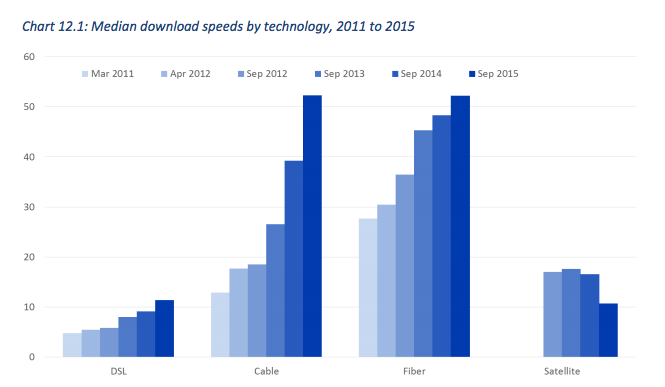
DSL performs worse than cable and fiber when it comes to matching advertised speeds, as DSL speeds are significantly lower for consumers who live farther away from the facilities that serve each neighborhood. Satellite services struggled, with actual speeds dropping because new customer additions and increased usage per customer cut into current capacity. Even DSL speeds crept up a bit in 2015, but satellite speeds went down: