“Our suspicion is that these guys don’t want to go to trial with anyone,” said Kniser. “And that theory is confirmed when they walk away for nothing.”
This is the second time in two weeks that Lodsys has avoided a decisive ruling about its business. Last week, the judge overseeing the case refused to rule on a motion by Apple that all its developers were licensed, because Lodsys managed to reach settlements “quickly and cheaply” with the seven Apple developers in this litigation.
The Lodsys worldview: You buy online, you owe us money
Lodsys owns just one “family” of four patents, which was previously owned by Intellectual Ventures. The two patents at issue in the Kaspersky case were 7,222,078 and 7,620,565.
It’s a classic troll situation. The ‘078 patent is a continuation of a continuation application, a way of essentially gaming the system to keep shifting claims while maintaining an earlier priority date. The patent shows a fax machine that asks a user for feedback about how effectively it operates, ranked on a scale of 1-5.
The accused Kaspersky product? The company’s “renew license” button, present in many of its software programs, which is nothing more than a hyperlink to an online store. By clicking that button, a customer was giving its “perception” of the product, Lodsys argued, thus treading on the claims of its patent.
Massive amounts of the documents produced by this litigation, unfortunately, remain under seal. Kniser has deposed Dan Abelow, the inventor behind Lodsys—but can’t reveal much about what he had to say. Instead, we focused on how Lodsys lawyers portrayed their patent claims in litigation.
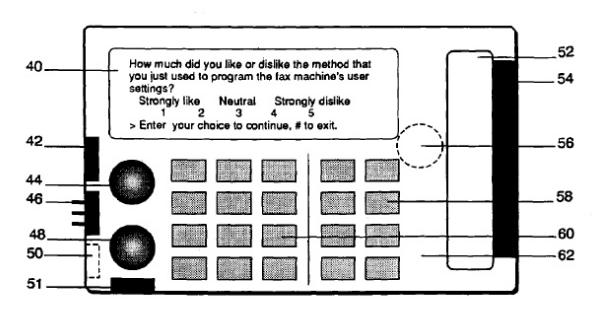
Credit: USPTO
The inventor’s work was based on work he was doing for Harvard Business School, which was experimenting with early computer-based instruction, said Kniser. “They wanted feedback on how students liked it,” said Kniser. “So they asked questions like ‘Could you hear the instructor? Could you print the screen that you wanted to print?’”