repeating isn't a flaw, it's how clarity is forged. with this in mind the whole theme of the article will be around how to use ai to build anything, break systems in modular structures, use ai to fail, iterate again fail again fail better, as ai doesn't get tired. it can fail 1,000 times in 10 minutes so you don't have to.
I have always enjoyed the 'old way' of inspecting through UI finding right CSS, de-minifying logic in DevTools, and manually analyzing network requests. but the fast era we are heading into demands output over process.
so let's explore the new way, where ai models can see and get the hard things done for you.
layer 1: visual reverse engineering
instead of trying to replicate a website entire UI in one go, start by choosing any particular component.
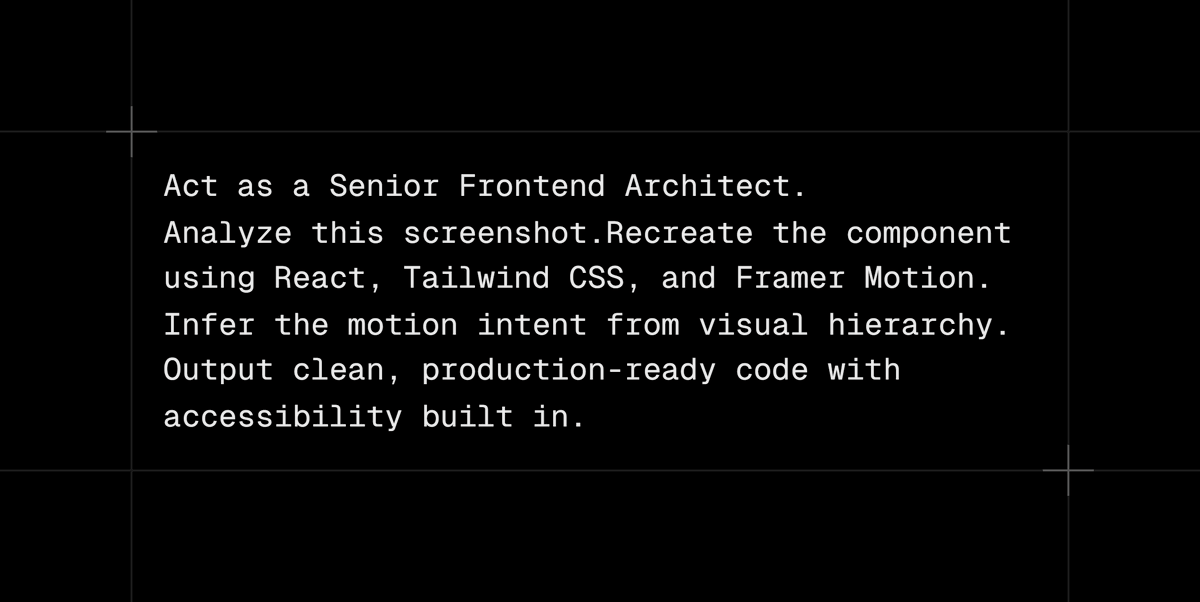
first attempt: screenshot it, send it to ai, get a rough component
second attempt: give a prompt to refine the spacing, colors, animation
third attempt: start adding interactions, states, edge cases
let ai fail on responsiveness, typography, then correct it.
v0 by vercel and lovable is currently the best tools for this purpose, as they also accept figma files directly.
also, claude opus 4.5 has a zoom feature to inspect tiny UI details at full resolution, better at inferring motion from screenshots, use it when you want to understand a design, why it exits the semantic understanding.
the only way to get the perfect UI is to iterate until perfect, so best of luck with that.
layer 2: de-minifying logic
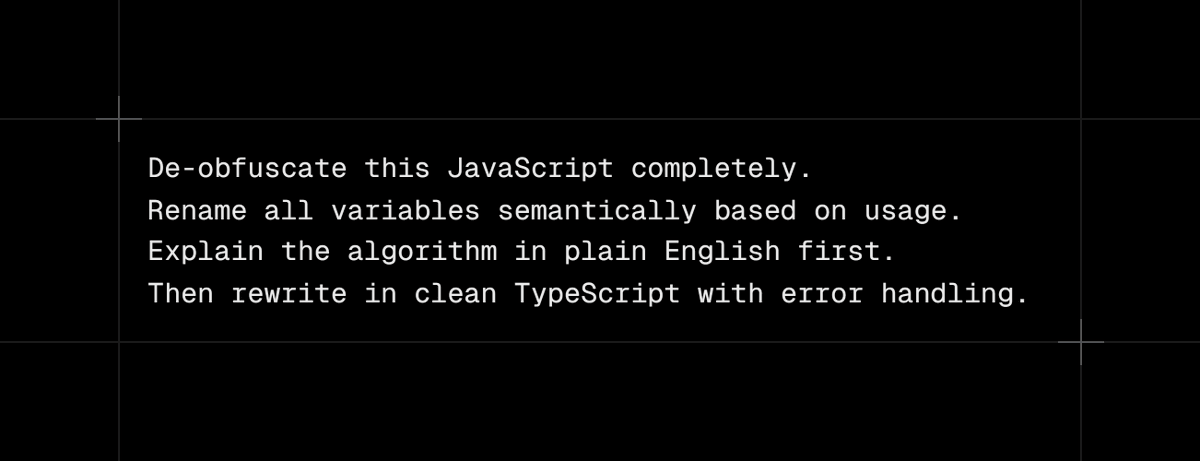
one of the hardest and time consuming thing is to make sense of obfuscated code, let's say you open devtools and see this:
i would have started to watch my favorite series, rather than pulling my hairs and give up, but time has changed we have gpt 5.2 codex and claude opus 4.5 both supports effort parameters and gpt scores 56.4% on swe-bench pro with 99.06% syntax accuracy.
as now, we have huge context window paste your entire minified bundle, let ai reason, it'll fail a lot, when ai tries to de-obfuscate. you spot a logical error variable 'a' seems to be a user object, not a boolean. tell ai, it regenerates with semantic names. you iterate until the logic is crystal clear.
honestly, this approach requires programming skills. it can be used just to fasten the process, because once the code is hashed it is a one-way function designed to be irreversible. making it a multi-iterative process and ai can shorten that process drastically.
layer 3: reverse-engineering APIs
this part is hardest to crack and the most crucial one, without knowing the backend architecture there is no use of above two layer. you can clone the UI perfectly, but if you don't know how data flows, what the server expects, how the database is structured, then you have a beautiful ferrari but without an engine.
but using ai abilities to fail through hundreds of api patterns, we got this.
manual process of finding the right request:
- start by identifying the api calls, open devtools, go to the network tab, make sure to clear any existing requests.
- look for requests with meaningful names(/api/download, /video/get, /generate-link), responses that contains JSON data structures.
- most of them are garbage, ads, tracking pixels, you can filter by clicking 'fetch/xhr' in the network tab to hide images, CSS and scripts.
- just when you find a suspicious request, right click the request and copy as cURL which will copy the heders, cookies, authentication, tokes, request body.
- paste it into postman or any other api platform, if the api returns same result, you've found your api call, if no try the next request which looks meaningful.
- it may happen you get unauthorized, missing auth token, bad request issue, for that ai to spot missing headers, wrong content, malformed JSON. instead of debugging yourself let ai do the repetitive part.
using ai to generate scripts and personal api:
paste the cURLcommand into gpt or claude and ask it to convert the command into a google apps script.
further prompt to make the script dynamic so it can accept different inputs (like different video URLs) rather than being hardcoded for just one.
you can also host the script as functional api, by making a new google apps script project, deploy the project as webapp. this will provide a unique url which can be used in other automation tools.
we've reverse-engineered one API call. now let's do the database schema inference:
- collect multiple api response and feel all do them to ai
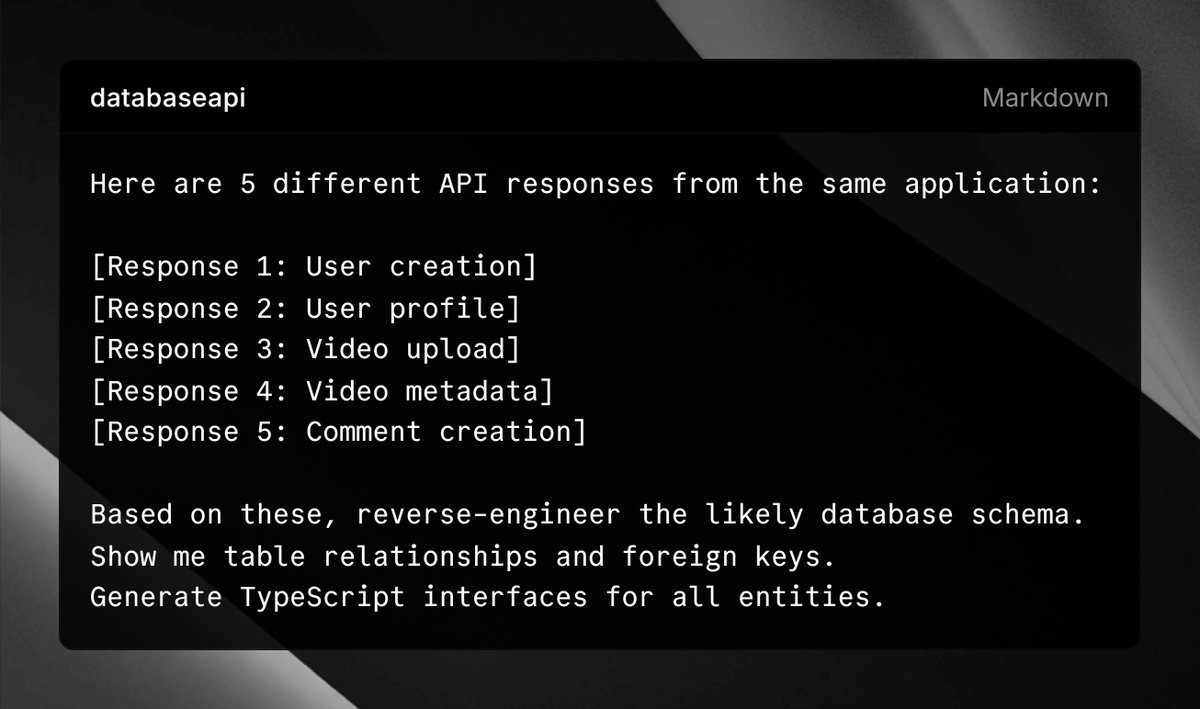
ai will start guessing the schema, after iterating and multiple correction you will have a complete schema with table structures, relationships, foreign keys etc.
if you have read till here you deserve the shortcut way also:
the HAR file shortcut:
instead of copying individual requests, go to network tab, right click and press "save all as HAR with content", upload that file to an OpenAPI converter or you can also paste it into any ai tool, which will give you a complete OpenAPI 3.0 spec auto-generated.
then you can prompt ai to :

this will give you entire api architecture mapped in 10 minutes, but the HAR files contains more than 500 requests and most are irrelevant, ai tries to find meaning in all of them, so make sure to prompt to ignore all requests to analytics, tracking, ads domains.
layer 4: the agentic way
this is for the lazy folks and non-coders with minimal setup band no hassle.
connect playwright MCP with your claude desktop, this allows agent to visits URL as per schedule or prompts, now your agent can click, scroll, type, maps sitemap automatically, create a report as technical architecture doc which can be exported. your role is to watch it fail, let's assume agent tries to login using wrong selector.
you tell: the login button has class .auth-btn, not #login". Agent adjusts, tries again, succeeds. Maps entire application structure in hours.
what still doesn't work(the honest truth):
- heavy string obfuscation (37.4% average error rate)
- complex redux/zustand state machine inference
- webassembly decompilation
- custom react hook pattern detection
- large codebase context
- sessions exceeding 30 minutes
even the best ai models hallucinates, our job is to let it try, spot the hallucinations, correct it or let it try again. ai is like a tireless intern, so make sure you to make the most out of it.
white hat only:
mentioned all approaches are to study and master problem solving.
don't: clone pixel-for-pixel designs. copy entire codebases. bypass authentication. violate terms of service.
instead add your own twist, as the more sources you learn from, the more original your work becomes.
reverse engineering isn't about theft; it's about deconstructing excellence to build something better today. go break something today.