Gaming
Why these three games were so damn great—and why the ending, good or bad, doesn’t matter.
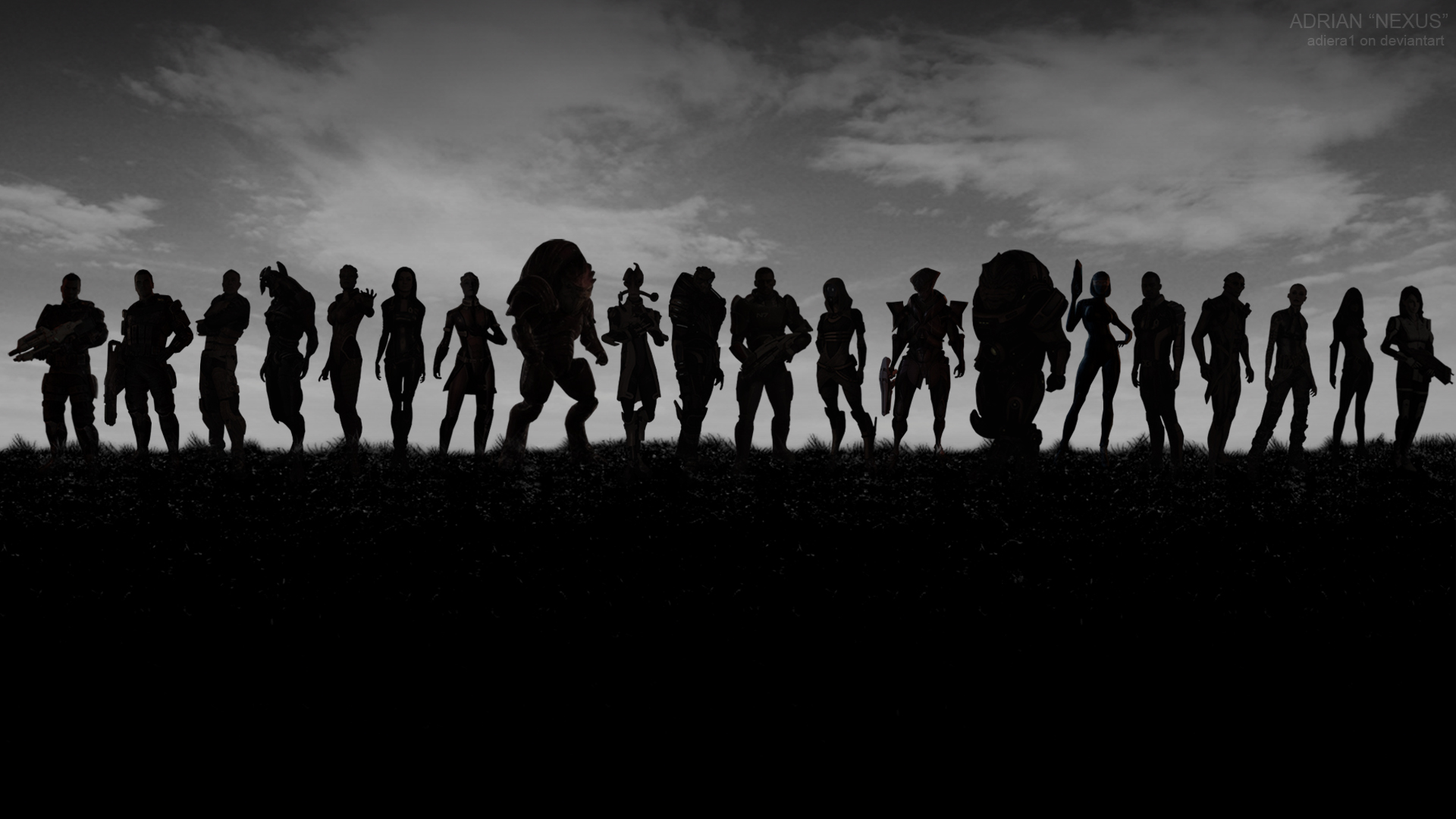
369 hours.
That’s nine 40-hour work weeks of time spent in the Mass Effect universe, according to the combined reports of Steam, Origin, and my creaky old Xbox 360. Eighty-six hours went into the original Mass Effect (three playthroughs), 189 hours into Mass Effect 2 (six playthroughs), and 94 hours into Mass Effect 3 (three playthroughs).
Commander Shepard and his crew—sometimes her crew, but we’ll get to that—have done plenty of galaxy saving under my control. They fought aliens, robots, clones, politicians, and reporters. They stood united against enemies vast and unknowably timeless. They have, in the words of James T. Kirk, “been through death and life together.”
They’re my friends.
OK, they’re not really my friends; claiming to be buddies with imaginary characters is a little too geeky even for me. The Mass Effect series is not without its flaws, and some are truly Reaper-sized. But it has gripped me like nothing else in the history of video games, and video games and I go back a pretty long way.
A brief video summary: what I learned from re-playing the Mass Effect series from start to finish.
As the first anniversary of Mass Effect 3‘s release approached in early March, I embarked on an epic playthrough of the entire Mass Effect series. My goal was not just to finish all three games but to see if I could actually role-play a character through the series. I wanted to take an angry, win-at-all-costs Commander Shepard and transform him through fire into a caring, compassionate leader who values the means as much as the ends. I found this to be both easier and far, far more difficult than I imagined.
Each game takes at least 30 hours to play properly, so I did a lot of my playing in eight to 10 hour stretches on weekends. My wife is sick of hearing me describe scenes and characters to her, but honestly, as the closing notes of “Farewell and Into the Inevitable” echoed through my headphones, I found myself sadder about the end of the epic three-game playthrough than I expected to be. Mass Effect is just that good, and I want to tell you why. It might not be for the reasons you’re expecting.
A note about spoilers: This piece is going to be filled front-to-back with spoilers from all three games. We’ll talk about plot arcs and choices, the fates of the characters, and the endings. By the time we’re done, we’ll have touched on tons of stuff across the entire series. If you haven’t played the games but still want to, this will kill a whole lot of the mystery and anticipation. This is your first and only warning!
Infinity and beyond
The Mass Effect universe is that rare thing—a fully-realized science fiction game setting that stands up to the likes of Star Trek or Star Wars. The universe in which the games take place has a rich and complex backstory, and even better, it’s not a rich and complex back story that the player has to have info-dumped into his head. This isn’t The Old Republic, where you have to read thousands of awful Kevin J. Anderson “Extended Universe” novels and have a working knowledge of the seven prime forms of lightsaber combat to get the most out of the game.
There’s depth in the backstory, but it’s not the kind of depth that ever compelled me to memorize the game’s codex entries. (Do you really need to know that the “First Contact War” between humans and Turians started because humans activated a mass relay in violation of council law and that the war culminated in the siege of Shanxi? No. It’s wonderful flavor, but it’s not mandatory knowledge.) The world is alive and compellingly real just through dialogue and character actions, without needing endless narration. The first game’s opening title crawl essentially says, “This is the future and aliens are real and you are a space soldier. Go.” That’s enough.
Instead of a galactic civics lesson, Mass Effect focuses on a human, the forever-first-nameless Commander Shepard, and his fight against the ancient Reapers, an enemy that aims to rid the galaxy of advanced sentient life for a whole bunch of really complicated reasons. That fight is the central focus of all three games, though Shepard’s path from soldier to savior twists and turns and doubles back on itself like a demented snake.
The feel of the Mass Effect universe permeates every scene, and in that way it feels a lot like other good Bioware games. In Knights of the Old Republic, for instance, you never forgot you were in Star Wars—the sounds, the colors, the costumes, the look and feel of each room and character were all carefully tuned. Mass Effect is the same. The future is a cool blue neon with glowing flecks all around it. Orange and yellow and green floating computer screens and omni-tools. People and aliens all dressed head to toe in form-fitting slickness. And curves everywhere—the future is dominated by curves, from the Mass Effect logo down to every nook and cranny on every spaceship.
A friend indeed
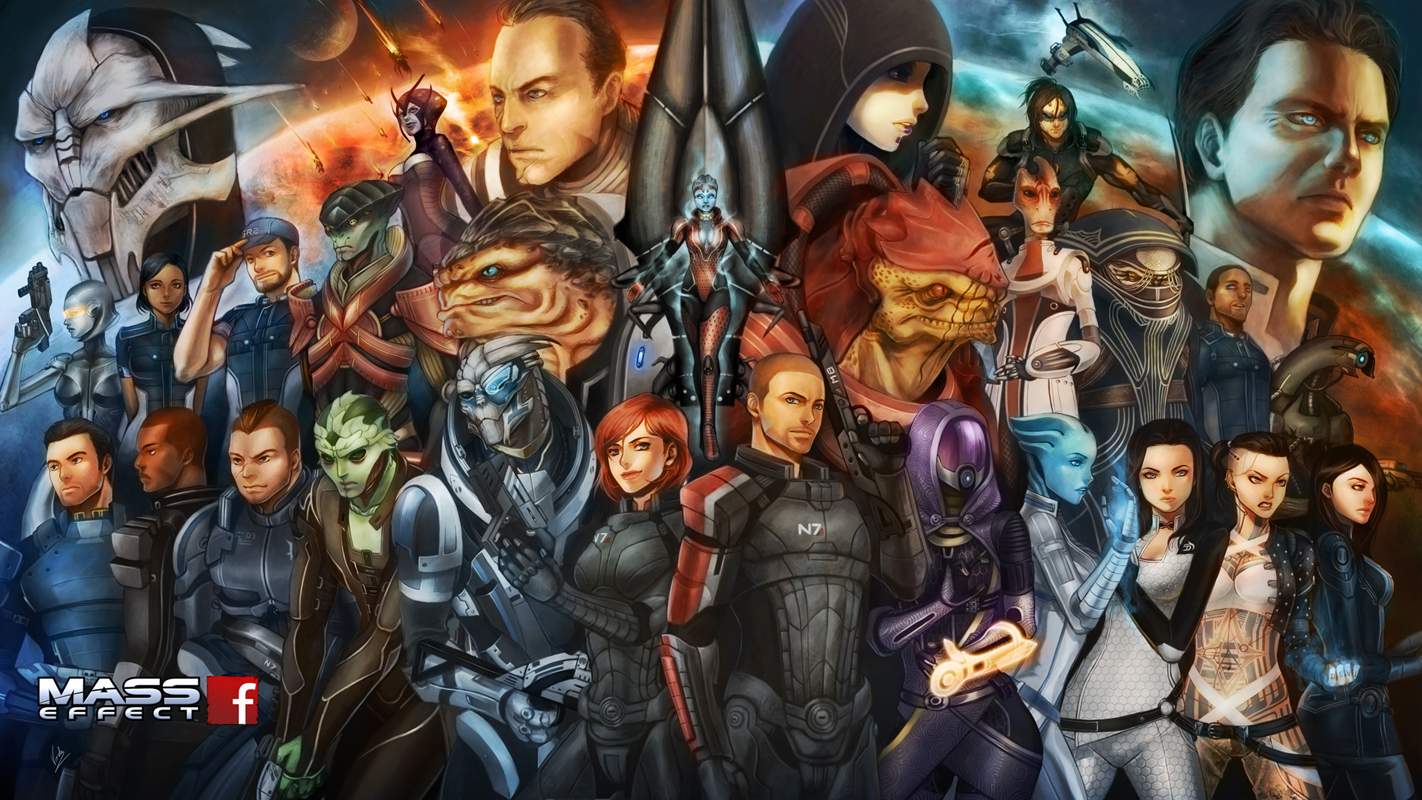
Mass Effect, by DeviantArt user virak.
Mass Effect, by DeviantArt user virak. Credit: virak
The Mass Effect games work because Bioware gives Shepard a ship, the Normandy, and then stuffs that ship full of powerfully realized teammates. It isn’t the worlds, the combat, or even the plot: it’s the people who make the story worth following. By the time Mass Effect 3 turns the corner to its final stretch, you’ve fought and bled and laughed and cried with this collection of humans and aliens for so long that it really does feel like the crew are friends, as dumb as that sounds.
In my playthrough of the entire series, the things I most wanted to experience again were the more personal character bits—most of which weren’t major plot moments. In Mass Effect, I wanted to listen to Garrus and Wrex and Tali rib each other during the Citadel’s interminably long elevator rides. In Mass Effect 2, I wanted to watch Tali and Shepard in the engine room as Tali says achingly poignant things to him about how long she has waited for him to notice her. More than anything else in Mass Effect 3, I wanted to watch Shepard shoot bottles with Garrus. I actually found myself rushing through major plot points and important missions. They were almost a chore I had to complete to reach the character moments I really wanted to play again and again.
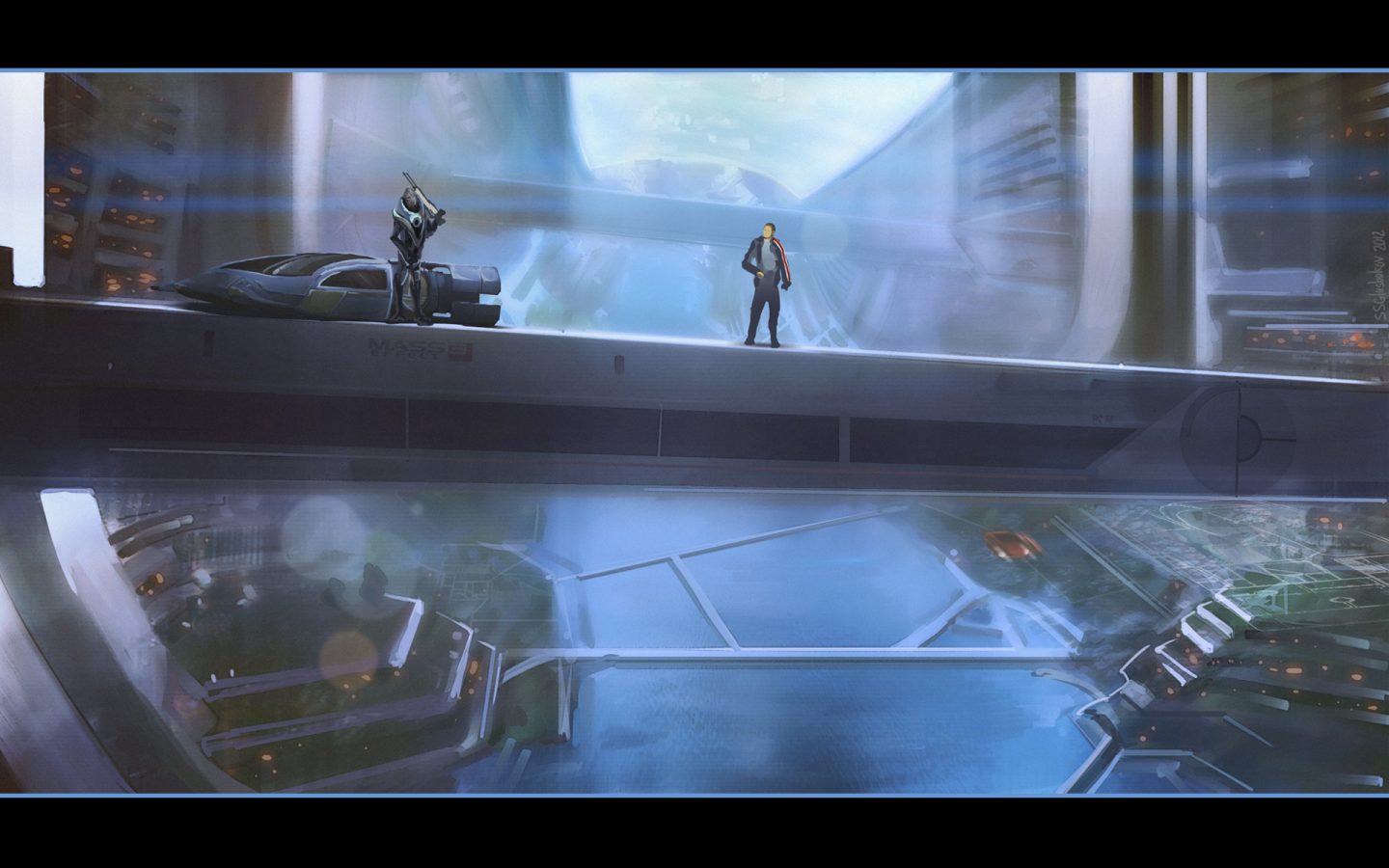
One of the finest moments in the entire series. Image is “King of the Bottleshooting,” by DeviantArt user SSGlushakov.
One of the finest moments in the entire series. Image is “King of the Bottleshooting,” by DeviantArt user SSGlushakov. Credit: SSGlushakov
The teammate interactions I was drawn to become more common as the series continues, to the point where it feels like the third game is absolutely swimming in rich, warm character moments. The parts that most made me stop and smile were when the crew talked to each other. It made the ship feel alive, and it made my squadmates seem real rather than cardboard cutouts waiting for Shepard to saunter by and kick off another dialogue wheel-driven conversation. When Garrus re-joins the crew in Mass Effect 3, the player can swing by Liara’s cabin to find her talking to him on the radio, asking if he’s all right after seeing his homeworld burning. It’s nice to see your friends, well, becoming friends themselves. For those moments, it didn’t matter that Saren or the Collectors or the Reapers were chewing up planets. I just wanted to listen.
As Mass Effect 3 progresses, more and more often you find the crew spending time in different spots on the ship. They’ll be hanging out on couches and shooting the breeze with each other, looking out windows, playing poker, and even drinking with each other. They’re not just manning their posts like automatons—they’re living. It makes the Normandy feel homey, almost like a shinier version of Serenity. The ship and her crew are a refuge. It gets cozier and safer as the game goes on and the galaxy tears itself apart. Even with the ever-present threat of cosmic annihilation bearing down, Shepard’s friends are there, ready to tell a joke or to just sit and watch the stars with you.
When squadmates get hurt, they rally around each other. After Thessia is steamrolled by the Reapers, the crew worries about Liara; it’s touching and insightful. Garrus’ emotional distance (“I don’t have any magic words”) is firmly in-character, as is Tali’s kindness.
The relative rarity of these moments in the earlier part of the series makes them more powerful. When Garrus brings up the first game’s long elevator rides during Mass Effect 2, Tali’s sotto voce “I have a shotgun” warning is excellent; Tali and Garrus trading “creepiest enemies we’ve ever shot at” war stories in Mass Effect 3 is even better. There’s a gratifying moment in Mass Effect 3‘s Citadel DLC pack where the crew argues about which version of the Normandy is better, the SR1 or SR2. This is exactly what I’d figure these characters would joke about.
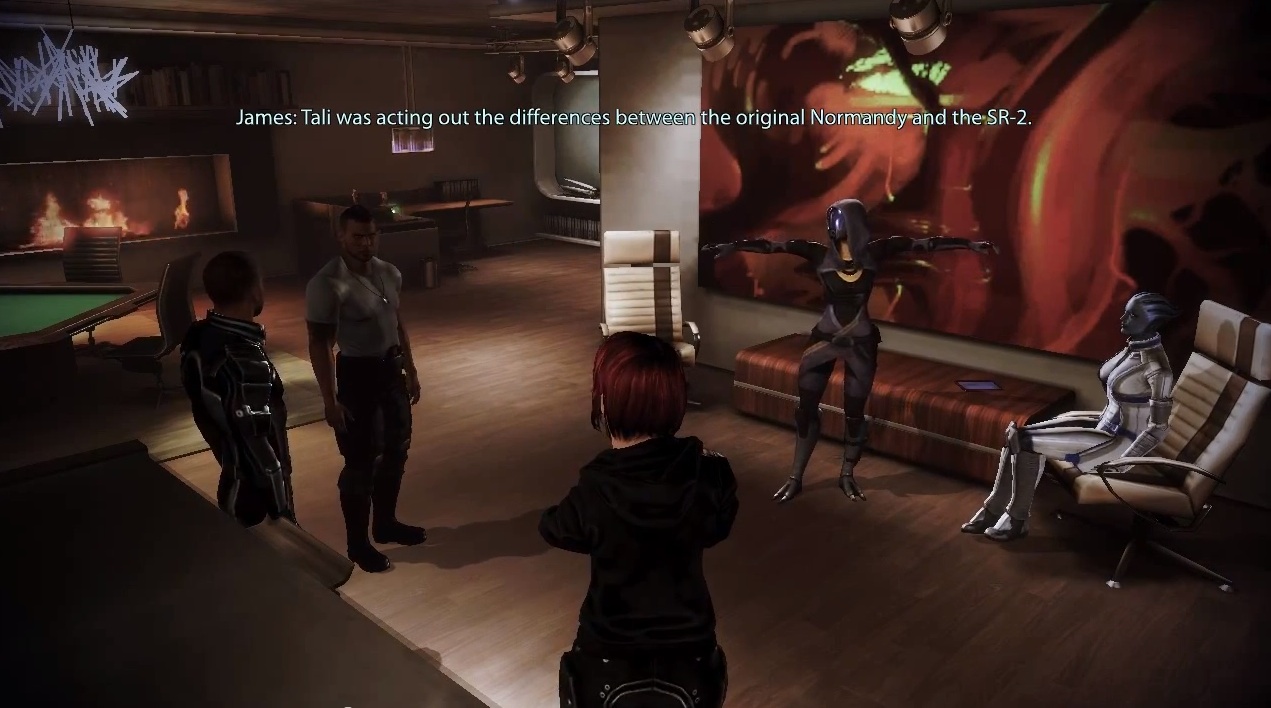
Oh, Tali. Don’t ever stop drinking.
Credit: Electronic Arts/Bioware
Oh, Tali. Don’t ever stop drinking. Credit: Electronic Arts/Bioware
The captivating character moments aren’t confined to Mass Effect 3, of course, though it has the lion’s share of them. The very reason the third game is able to have so many powerful beats is because the previous two invested time and effort into character building. The series uses the luxury of time to allow the player to befriend the crew and to let the crew be changed by the player.
Mordin Solus is a perfect example. He’s given an interesting introduction, but as Mass Effect 2 progresses, more aspects of his personality are filled in and the character begins to grow and change. Mordin’s backstory is one of the most realistic and engaging out of all of them, making his fate in the third game that much more powerful. He expresses regret over how his scientific work has been used, reflecting on the dead female Krogan during his loyalty mission. He moralizes and justifies the Krogan genophage, then later comes to realize that some things cannot be moralized. He even sings some Gilbert and Sullivan.
Mordin’s (almost but not quite inevitable) death is a well-orchestrated key dramatic moment in the entire series. A minor character dying in the same way wouldn’t have carried nearly the same emotional freight. In fact, it’s possible to play the game with a substitute sacrificing himself in Mordin’s place. The act is no less noble, but the impact is significantly lessened.
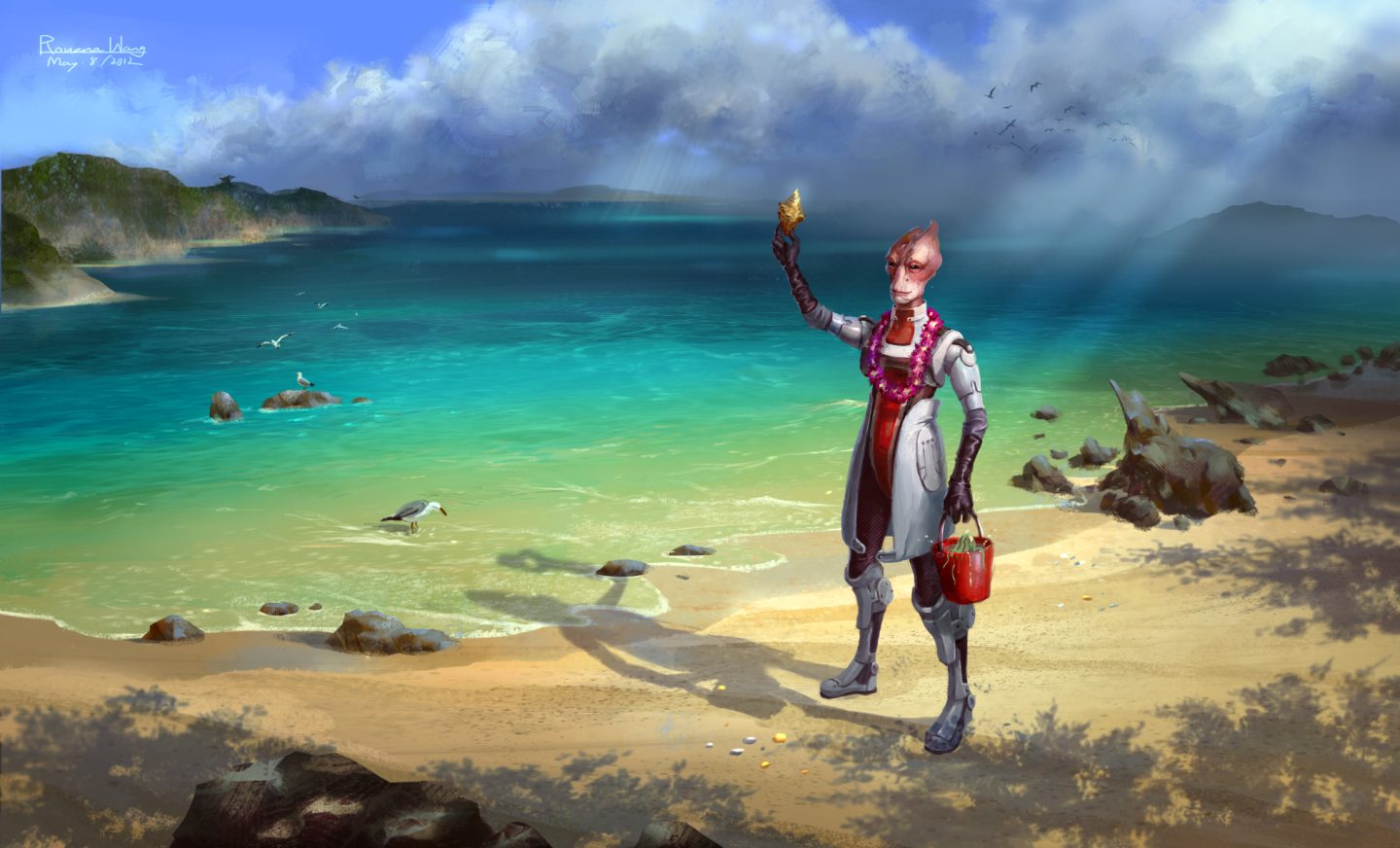
Might run tests on the seashells! Image is “Mordin the Great Marine Biologist,” by DeviantArt user uriska.
Might run tests on the seashells! Image is “Mordin the Great Marine Biologist,” by DeviantArt user uriska. Credit: uriska
Another more personal example is Jack. Even though her character is sketched with broad and hackneyed strokes (she’s a loner, Dottie—a rebel), her growth from violent psychopath to leader is a gratifying transformation, in no small part because it’s directly attributed to Shepard’s influence. Jack doesn’t save an entire species and end a centuries-old conflict, but she does transform into a likable character. Watching her guide her own group of biotic students through a Cerberus attack in Mass Effect 3 is rewarding. Even as the galaxy burns, Shepard can still save people indirectly through his protégés.
Amidst the galactic-scale war and the shattering of whole worlds, the series finds time to feature Shepard’s squadmates in a handful of quiet, perfect moments, strung together like beads on a fine chain: Liara delivering her time capsule to Shepard’s cabin; or at the end of the game, resting her head against Shepard’s shoulder while sharing memories. Shooting bottles with Garrus and letting him win. Tali’s picture. The long goodbyes with the key characters before the final battle. And the Citadel DLC (we’re getting there).
Through a hundred hours of fighting and war, it finally becomes apparent that the game was never about Commander Shepard winning the war against the Geth or about the Collectors or about Cerberus or about the Reapers. It was about the journey and about the friends you meet along the way. Your squad of aliens and humans and the occasional robot is the story.
Romancing the stars
Though the original Mass Effect was a bit clunky with its character’s romantic interactions, it included three potential love interests for Commander Shepard. We consumers of Western media are trained to expect some romance in our drama. Conventional entertainment wisdom says that characters going through shared experiences in TV and movies will almost inevitably fall in love. It’s a convenient device for capturing the audience’s interest and securing their emotional investment, and it happens in computer games too.
The three-part series provides an interesting dramatic crucible for Commander Shepard and his paramour—or paramours. Bioware elected to separate the player from all three of the first-game romances in the second game and instead presented an entirely new set of romance options for Shepard. Whether or not Shepard pursues a new relationship comes to a head in the third game, where Shepard must choose between love interests.
As the games progress, the relationships become more adult. Not “adult” like “full frontal alien nudity,” but rather more mature and believable—less like a video game parody of romance and more like real people interacting. In Mass Effect, the player is railroaded through dialogue choices and you have to actively try not to end up in bed with someone. In the second game, though, Bioware slows down and the romances gain some introspection.
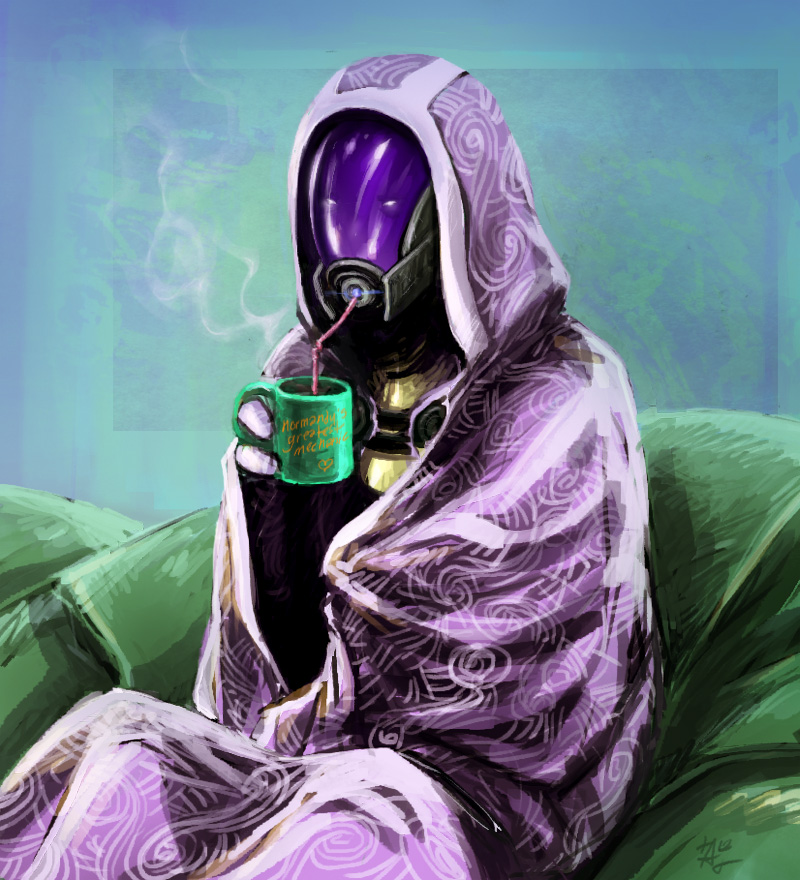
Tali demonstrates the usage of the emergency induction port. Image is “Tell Me Again About Your Immune System” by DeviantArt user amrrr.
Tali demonstrates the usage of the emergency induction port. Image is “Tell Me Again About Your Immune System” by DeviantArt user amrrr. Credit: amrrr
In fact, the budding relationships that should be the most comical—Shepard falling in love with the alien Garrus and his crazy cat-bird-looking face, or Shepard falling in love with enviro-suit-bound Tali, or even Shepard falling in love with green lizard-assassin-man Thane—instead turn out to be heart-stoppingly well done. The characters are so well-crafted and so expertly realized that in the end it doesn’t matter that they’re aliens. They’re people first.
My own romance preference has always been for Quarian engineer Tali’Zorah. I originally switched from playing a female to male Shepard when Mass Effect 2 was released precisely because it was revealed that Tali would be a romance option. (I’m not alone, based on the legion of “Talimancers” clogging up message boards everywhere attests.) The character has an extremely vocal (and occasionally creepy) following.
I kept Tali in my Shepard’s crew for the first game mainly because her hacking skills enabled me to get into locked chests and doors. In the second game, though, she stopped being a walking Quarian Wikipedia entry and became one of Shepard’s staunchest supporters. It’s touching to watch her character gain confidence through interacting with the player and the rest of the crew, and she radiates fierce devotion to Shepard (“You are real,” she tells him near the end of Mass Effect 3 after he’s given cause to doubt his own humanity. “Real, and mine”).
Similarly, Garrus is a ridiculously popular romance choice among FemShep players. Even though both Garrus and Shepard express a bit of incredulity at the idea of getting together (and I’m still not sure how they’re supposed to, you know, do it), the pairing works beautifully. It helps that voice actor Brandon Keener imbues Garrus with exactly the right mix of charm and earnest bashfulness. I see Garrus as Shepard’s best friend, whether male or female; they’re together for the majority of all three games, and it’s easy to see how circumstances might drive these two warriors into each others’ arms. The scene where Shepard and Garrus say goodbye to each other before the final battle is absolutely wrenching, and actor Jennifer Hale’s broken-voiced delivery of the final set of lines is dead-perfect. It feels like a punch in the gut.
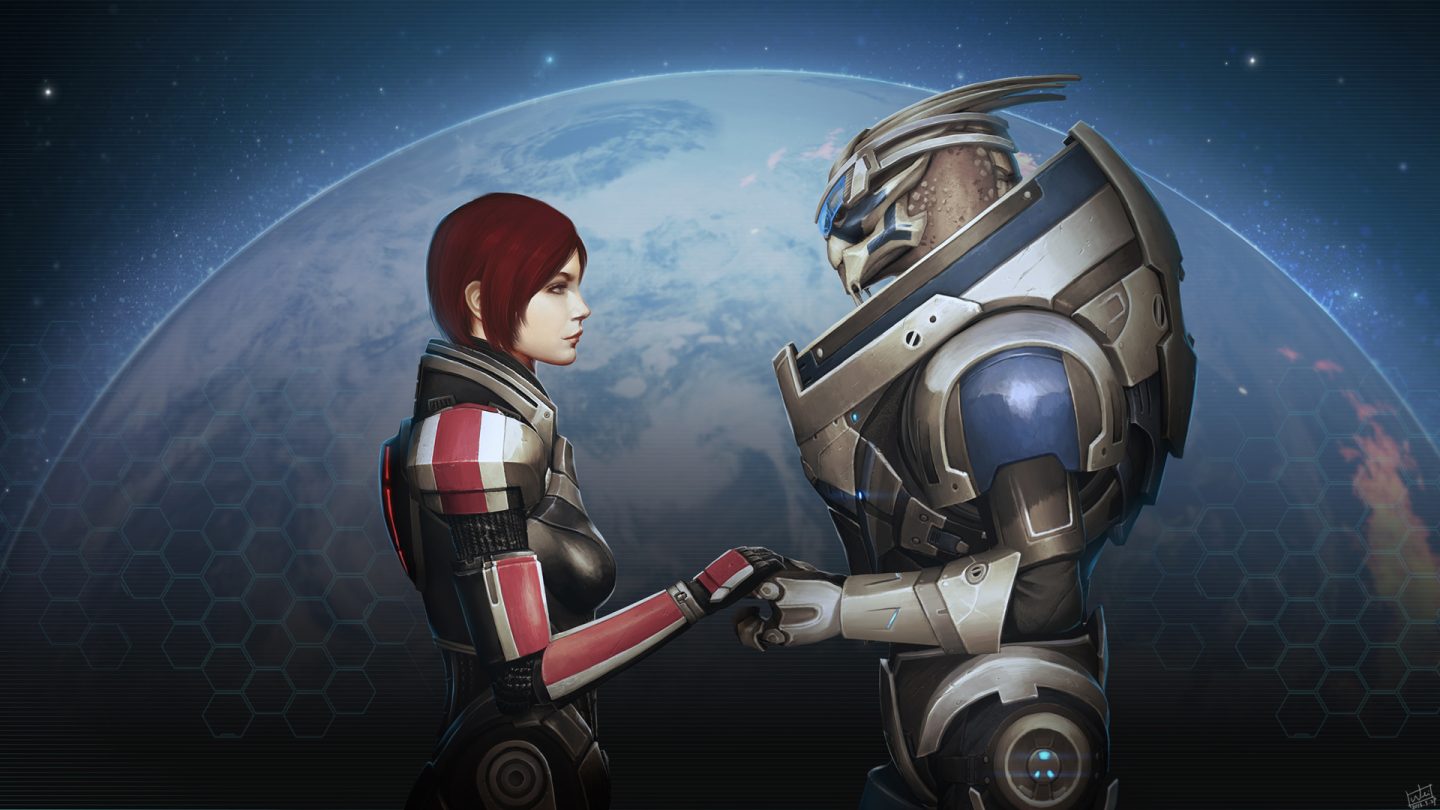
Garrus and FemShep are an overwhelmingly popular romance choice. Image is “I’m With You,” by DeviantArt user Wei723.
Garrus and FemShep are an overwhelmingly popular romance choice. Image is “I’m With You,” by DeviantArt user Wei723. Credit: Wei723
Video game narratives sometimes have to resort to clichés that wouldn’t really be acceptable in a modern movie or TV show; the emotions have to be telegraphed such that they can be felt through sometimes-clunky 3D characters and voice acting. Where games like the Mass Effect series get leeway, though, is via the player’s direct involvement in the drama and decision-making. It’s a testament to the writing and to the skill of the voice acting crew that Bioware has assembled for this trilogy that the dramatic moments in Mass Effect can elicit raw emotions from players, even though some of those same moments might draw groans if they happened on the big screen. But if you’ve played the games and gotten attached, it’s hard to watch the characters saying goodbye to each other. It feels like hacking off bits of yourself and leaving them behind.
Why we fight: It’s not for them
I lost my brother almost ten years ago in Iraq; he was serving in the 101st Airborne (2-502 INF, “Strike Force”) and was killed by an improvised explosive device in Mosul on December 7, 2003. I was lucky enough to be able to spend some time after he died with the other soldiers in his company, and they echoed a sentiment I’ve heard expressed before both in fiction and in life: soldiers don’t fight for their country, or their leaders, or even their ideals. They fight for each other.
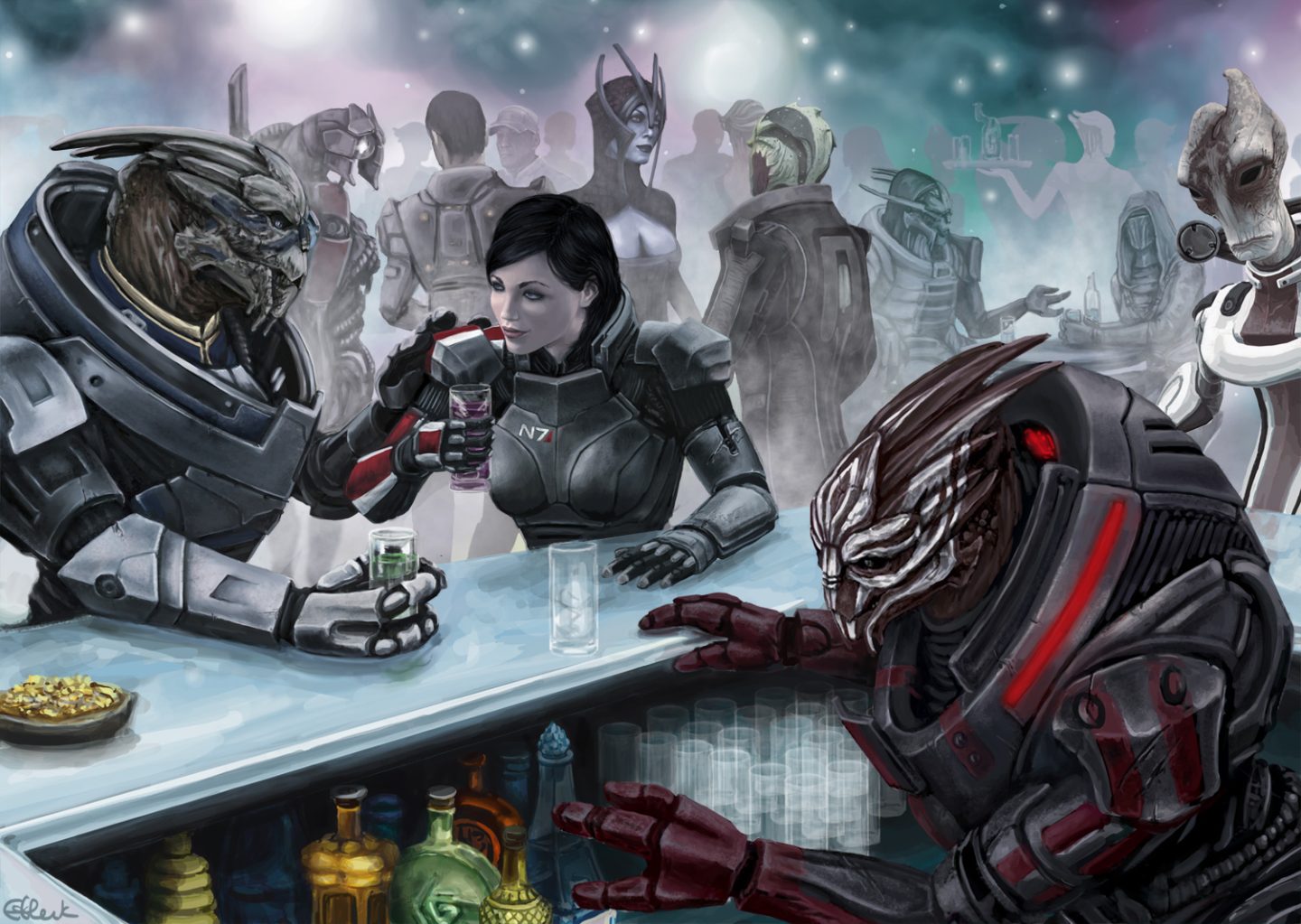
“Not sure if Turian heaven is the same as yours, but if things go sideways and we both end up there…meet me at the bar.” Image is “Meet Me at the Bar” by DeviantArt user efleck.
“Not sure if Turian heaven is the same as yours, but if things go sideways and we both end up there…meet me at the bar.” Image is “Meet Me at the Bar” by DeviantArt user efleck. Credit: efleck
Mass Effect‘s brilliance, and the brilliance of its characters, is that it drew from me some similar feelings of loyalty and devotion to my squad. That bond made a full “role-playing” replay of all three games difficult. This is coming from the guy who’s never done a “light side” playthrough of Knights of the Old Republic—I’ve force-choked my way across the galaxy a half-dozen times and laughed as I did it. My first time through Mass Effect years ago was played as a horrible reporter-punching crazy person. My grand role-playing tour of all three games required me to start Shepard out in a dark place: a veteran of Torfan, where he learned that the ends justify the means. This set the stage for him to experience an archetypical hero’s journey, and learn through experience that in the war against vast powers and principalities, small personal victories matter just as much as large campaigns.
As I started up Mass Effect in this light, I struggled. It was impossible to sustain that level of arrogance and meanness, even though I knew it was a game. I kept running into characters I loved. I wanted to hug Garrus the first time I saw him.
Foreknowledge of the “best” outcomes of all the many series plot lines also ended up interfering with a lot of the “role-playing” decisions. In some situations, even if I felt Shepard likely would have chosen the “renegade” dialogue option, knowing the potential negative consequences made it impossible make the choice. Squadmate Liara T’Soni’s naïveté grated heavily on renegade Shepard on my long-ago first playthrough, but knowing how good a friend the character is destined to become made me soften my approach this time.
Hell, I couldn’t even be mean to Conrad Verner—as funny as it is to shoot the poor guy in the foot in Mass Effect 2, I couldn’t do it. He’s harmless, and I actually looked forward to meeting him in each game. He even helps Shepard out in Mass Effect 3, tying together an entire mess of fetch quests in the first game that would otherwise have been left hanging.
One thing that was easy to do, though, was hanging up on the Council. Repeatedly. Joker is right: that never gets old.
The ending: You know we have to go there
We all know how the series ends: a grievously wounded Commander Shepard has a long conversation with an AI about the nature of the Reapers, and the player is then presented with three (later updated to four) unpalatable choices on how to save the galaxy. There’s been a lot of digital ink spilled talking about whether the ending was “good” or “bad,” or whether it violated the game’s internal consistency or broke the rules of drama, or how someone’s particular Commander Shepard character would have come up with a better option.
It doesn’t matter.
The ending of Mass Effect 3 has absolutely no bearing on the journey that the player took to get there. Articles discussing the ending of the game draw commenters who say that the ending destroyed the entire experience of the game and ruined everything and also killed their dog. But I would argue that no ending can invalidate the rest of the game or take away the incredible experience of playing the series.
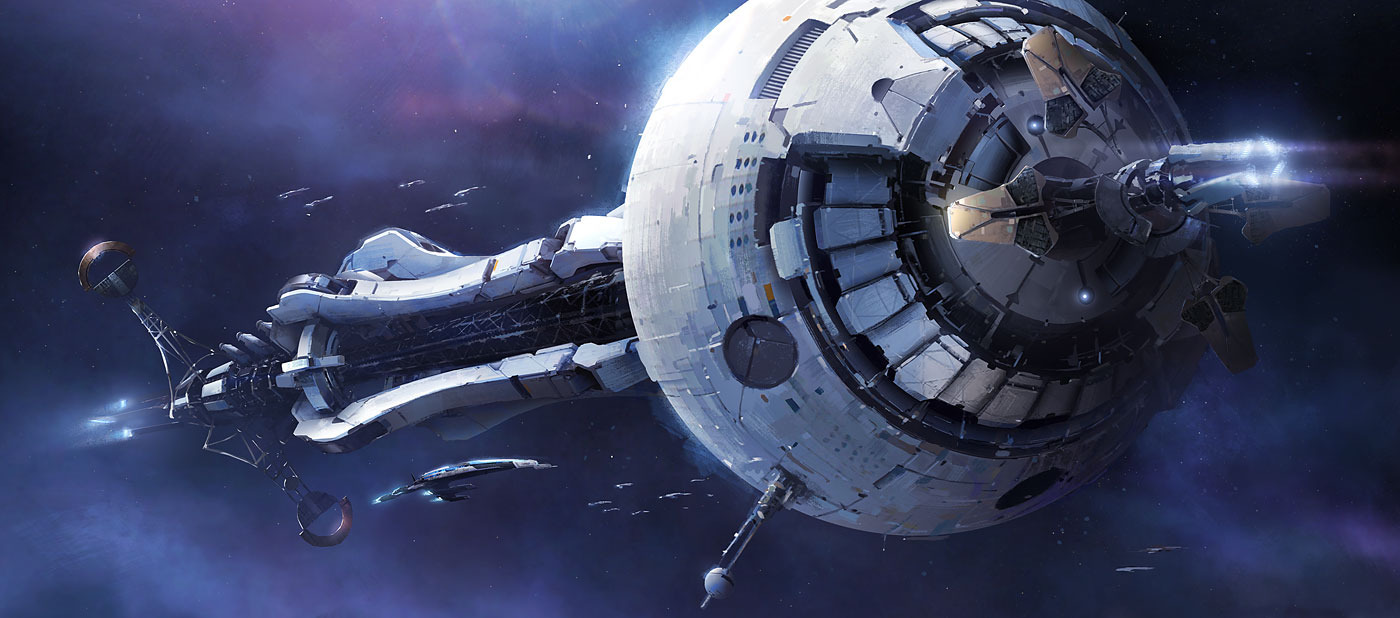
Crucible concept art, by Bioware artist Brian Sum.
Crucible concept art, by Bioware artist Brian Sum. Credit: Brian Sum
I’ll be the first to say that I didn’t particularly like the ending of Mass Effect 3. I didn’t buy into the “lost human child represents everyone Shepard couldn’t save” thing Bioware was trying to pull us into; I utterly failed to connect with the kid character. I think Bioware missed an incredible opportunity to instead use the character sacrificed on Virmire—either Kaiden or Ashley—as the analog of the Catalyst and the face of all those Shepard couldn’t save. The dream sequences and the final conversation would have worked a hell of a lot better if they had featured a ghostly Kaiden or Ashley instead of some random dead kid (who, let’s be honest, died because he was too stupid to listen to the trained soldier trying to save him from monsters).
But, frankly, who cares? The ending of Mass Effect 3 is about fifteen minutes long. That’s fifteen minutes of “meh,” capping off a bit more than 90 hours across three games. Complaining about it is like going to a Michelin three-star restaurant, having an epic multi-hour prix fixe dinner, and then at the very end realizing that the coffee they’re serving with your post-dinner cigar is Taster’s Choice. Sure, it leaves a bad taste in your mouth because it’s the last thing you get to experience, but it doesn’t take away from the fact that you just had an epic multi-hour dinner you’ll remember forever.
What matters, and what I care about, is that the series introduced me to so many incredible characters and let me hang out with them. The journey matters far more than the destination. And, as it turns out, the journey didn’t end at the Crucible. The crew of the Normandy had one more stop to make.
The end is not the end: The Citadel DLC
The ending was revised with the “Extended Cut” DLC, but Bioware pulled out all the stops in the final downloadable content pack for Mass Effect 3. The company capped the entire series with a beautiful goodbye stuffed full of moments between the crew: the Citadel DLC. I wrote about it when the DLC was initially released, but now I’ve spent several additional hours playing through all the variations. This is the true ending of the series.
The Citadel DLC is like that adorable late-season episode of a TV show, where the writers let their hair down and poke fun at the formula. It’s Mass Effect‘s Musings of a Cigarette Smoking Man or Bad Blood; things go a little off the rails, but it’s all right because everyone, from the players to the characters, is in on the joke. It’s pretty clear that the Citadel DLC is what Mass Effect series producer Mike Gamble was hinting at when he tweeted last year, “Seriously, if you people knew all the stuff we are planning…you’d hold onto your copy of me3 forever.” He was right.
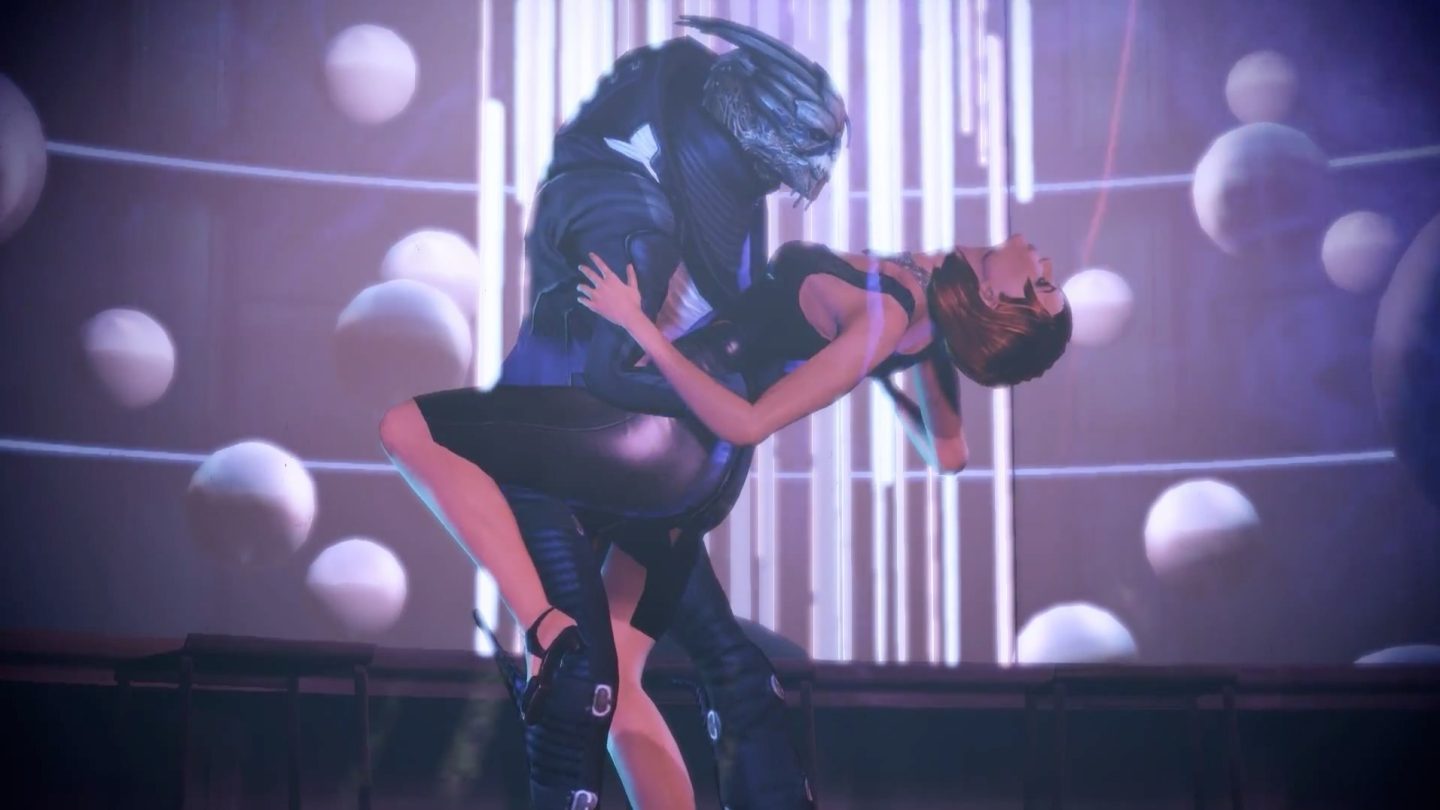
Why, yes, that is Commander Shepard and Garrus Vakarian dancing the tango. This essentially summarizes the tone of the whole DLC pack: it’s irreverent, and it’s awesome.
Credit: Electronic Arts/Bioware
Why, yes, that is Commander Shepard and Garrus Vakarian dancing the tango. This essentially summarizes the tone of the whole DLC pack: it’s irreverent, and it’s awesome. Credit: Electronic Arts/Bioware
Trying to slot the ebullience of the Citadel DLC into the structure of the game is difficult. The “correct” place to play it, from a dramatic standpoint, is immediately before tackling Thessia. This fits with the rising mood of the game, coming off of a string of wins against the Reapers. The exultation of kicking Reaper ass on Tuchanka and Rannoch flows right into the upbeat content. Then, post-Citadel, Shepard’s stunning defeat on Thessia puts the appropriate dampening on the mood and real life crashes back in. From there, it’s one hard ride with no breaks to the end.
Unfortunately, this sequence means skipping or delaying a fair amount of the non-shooting portion of the DLC, since many of the character interactions can only be unlocked by completing sidequests in the main game. In order to encounter all the crew and see everything in a single go without having to come back over and over, you need to wait until all main and side quests are finished except for the assault on the Illusive Man’s base and then run the DLC mission. This is problematic from a plot standpoint, as the upbeat DLC blows the dramatic tension of the game right out of orbit.
But there’s a third option. You can play the Citadel DLC after the end of the game. As a final goodbye situated after Mass Effect 3‘s credits—which is where most players will encounter the pack anyway, since it was released almost a year after Mass Effect 3. It’s a blast of joy that clears away having to sacrifice yourself and/or your crew to save the galaxy. It is, as the old fellow after the credits tells the kid, one more story.
And what a story. The Citadel DLC plays like the best fan fiction ever come to life. For the entire series, you’ve had to pick a pair of squadmates to accompany you on missions; here, for the first time, you get to watch your entire squad fight, and they dominate the battlefield. They shoot almost as many jokes and quips as they do bullets at the enemy, forming up into two fire-teams (“Team Mako” and “Team Hammerhead”—come on, how awesome is that?) and arguing with each other over which team is better. If the message of the series is that we all must stand together, the Citadel DLC personifies that.
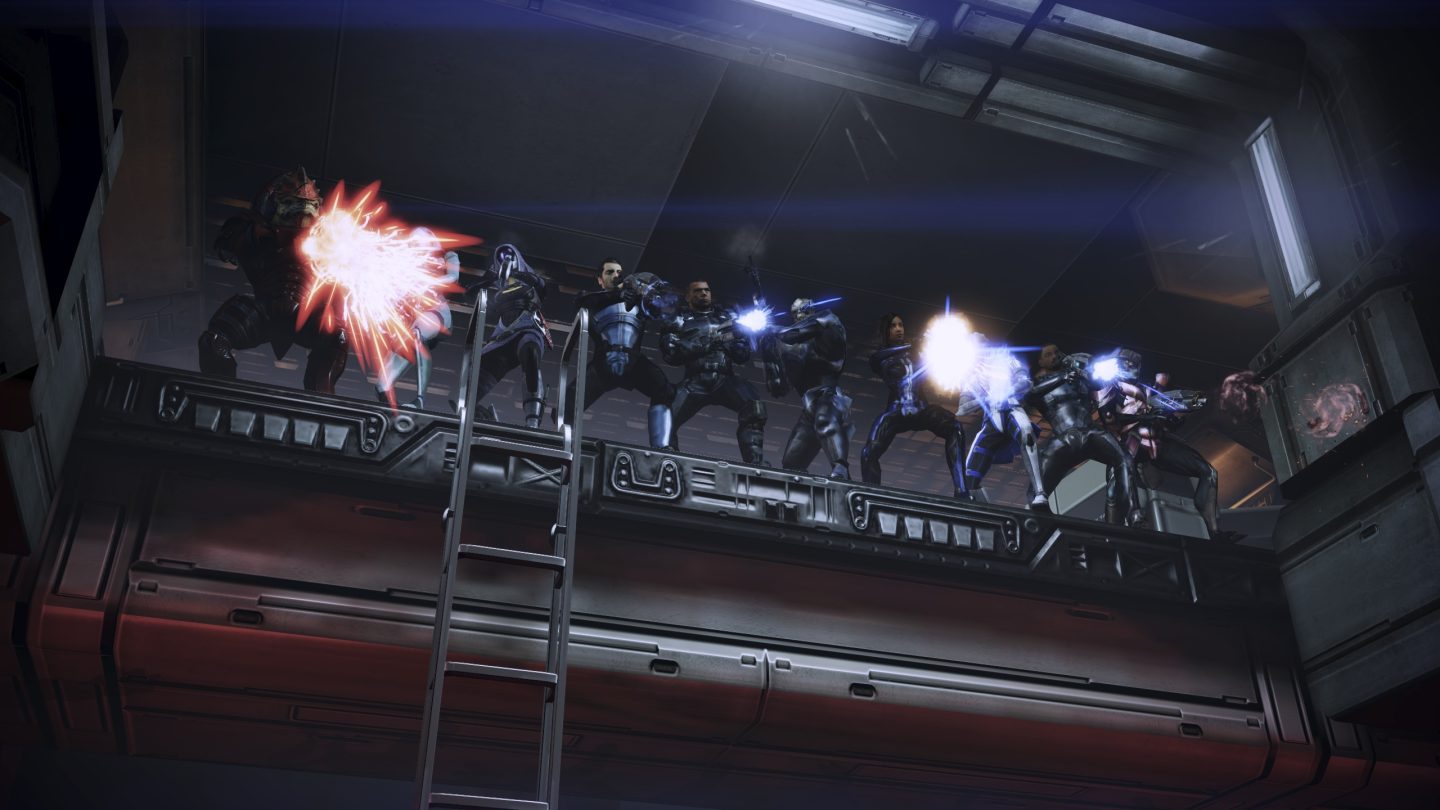
If you could take the entire crew of the Normandy with you on every mission, it’d be a much shorter game.
Credit: Electronic Ars/Bioware
If you could take the entire crew of the Normandy with you on every mission, it’d be a much shorter game. Credit: Electronic Ars/Bioware
Everyone likes being part of a group, and during the party the characters spout off in-joke after in-joke and talk openly about past fights and situations. It feels like a peek behind the curtain into the lives of these characters, and it brings more closeness than an entire game of battlefield conversations. I could write an entire piece just discussing the after-mission party, but after so many hours of watching Shepard and his team fight and bleed, watching them party—literally party—is an almost ridiculous relief.
The Citadel DLC is the hidden happy ending of the Mass Effect series, and in spite of all its craziness it works. Those are our friends hanging out and dancing and drinking with each other, and our friends are finally, truly, unapologetically happy.
It feels right. It feels like they deserve it. But there’s an overlooked tragedy in all of this.
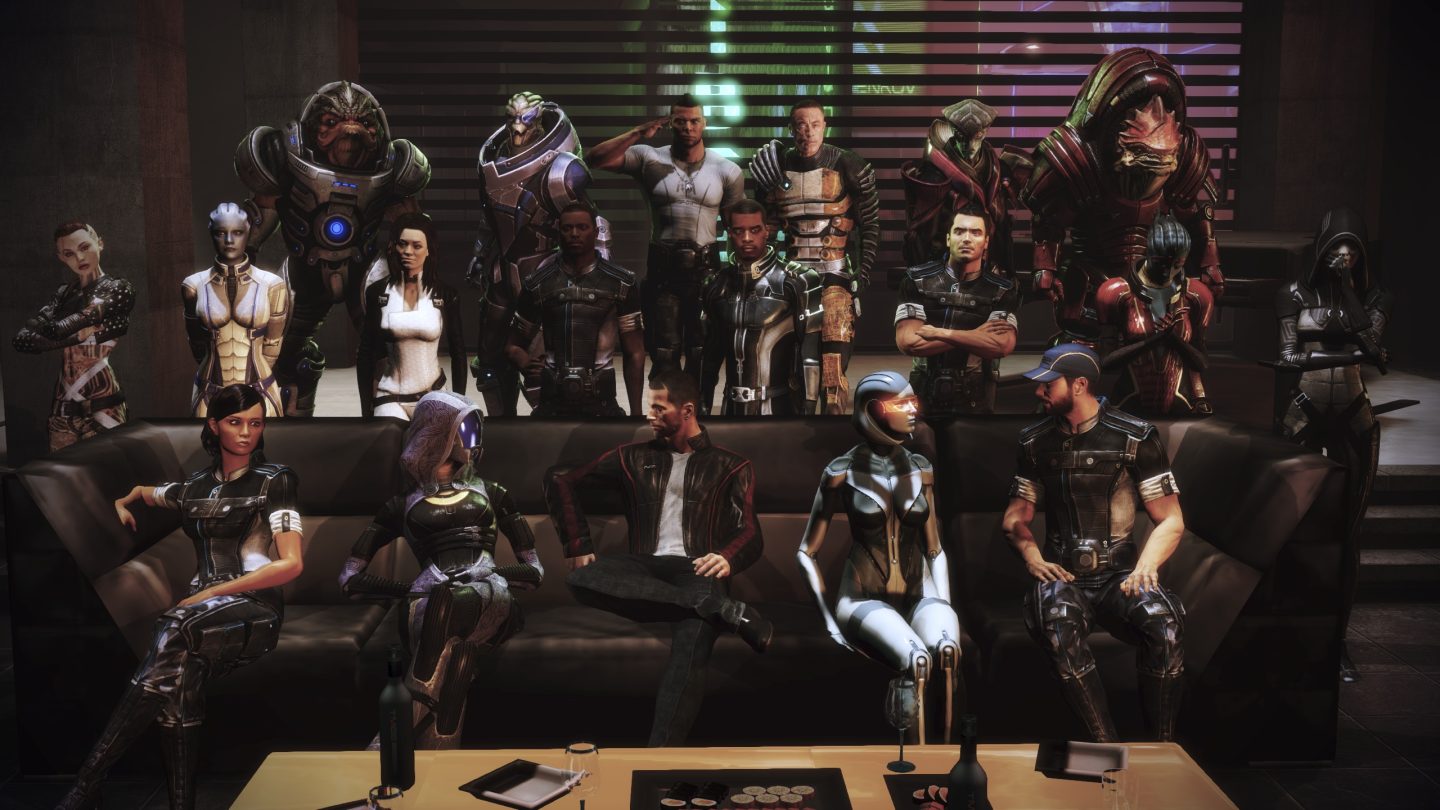
One last picture with everyone. Well, almost everyone—sadly, there are a few who can’t be there.
Credit: Electronic Arts/Bioware
One last picture with everyone. Well, almost everyone—sadly, there are a few who can’t be there. Credit: Electronic Arts/Bioware
The secret life of Commander Shepard
It’s easy to focus only on the crew, but I’ve avoided talking much about Commander Shepard himself. Who is he, and how is he able to draw together a squad of so many wonderful characters and keep them motivated and fighting?
Shepard is no one, which lets Shepard be you. There are few places in the entire game where he expresses a “canonical” opinion—that is, an opinion that isn’t dependent on a player’s paragon or renegade dialogue choice. There are even fewer places where he talks about his own feelings. Other than the archetypical hero values of duty and honor and service—which renegade and paragon Shepard both basically share—Shepard is a cipher.
At the end of the Lair of the Shadow Broker DLC pack for Mass Effect 2, Liara asks Shepard how the ongoing fight against the Collectors and Reapers is making him feel. It was the first time I’d noticed any of the characters actually asking their commander that question. I was surprised but gratified to see that one of the potential answers was that Shepard was tired—tired of shouting that the Reapers were coming and tired of being ignored.
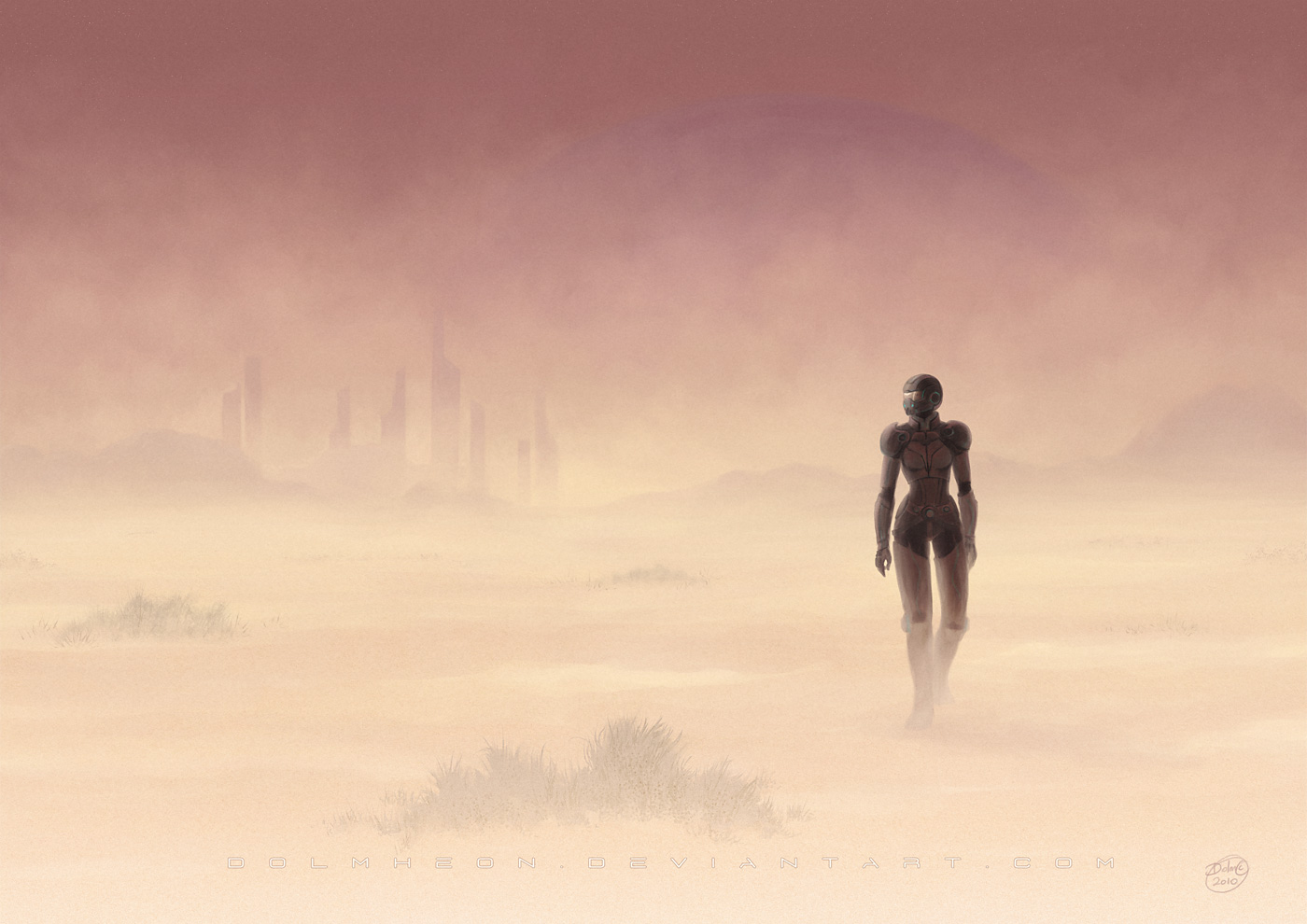
No one can be Shepard alone—not even Shepard. Image is “Wanderin'” by DeviantArt user Dolmheon.
No one can be Shepard alone—not even Shepard. Image is “Wanderin'” by DeviantArt user Dolmheon. Credit: Dolmheon
The moments where Shepard is allowed to have an opinion independent of the player are precious and few, and in most of them he expresses exhaustion or frustration. But there are scattered others; one in particular that stuck with me was in the Citadel DLC. If the player chooses to start with a “quiet” party rather than a loud one, some of Shepard’s squadmates josh him that the party is too low-key. Shepard, seated on the couch, replies with a friendly, “I like it this way.”
The crew knows him, though, with a familiarity that we players can never experience. When Liara asks Shepard to describe himself for the time capsule she plans on stashing away, the dialogue option I invariably choose is the one where he tells Liara that she knows him well enough to write the entry herself.
The tragedy of Mass Effect isn’t that Commander Shepard dies in the end; the tragedy is that even as his crew is allowed to grow, Shepard is, ultimately, personless. He is denied even a first name—something the other characters remark on. Even as Shepard battles avatars of the Reapers, he is himself the avatar of an unstoppable, unknowable power—the player.
We don’t get to see him eventually set free of the player’s agency, to live on his own terms, with his friends in a “happily ever after” ending. His actions, your actions, define him—that “the deeds make the man” is one of the axioms of the Mass Effect series—and he remains sadly empty.
It’s been the best
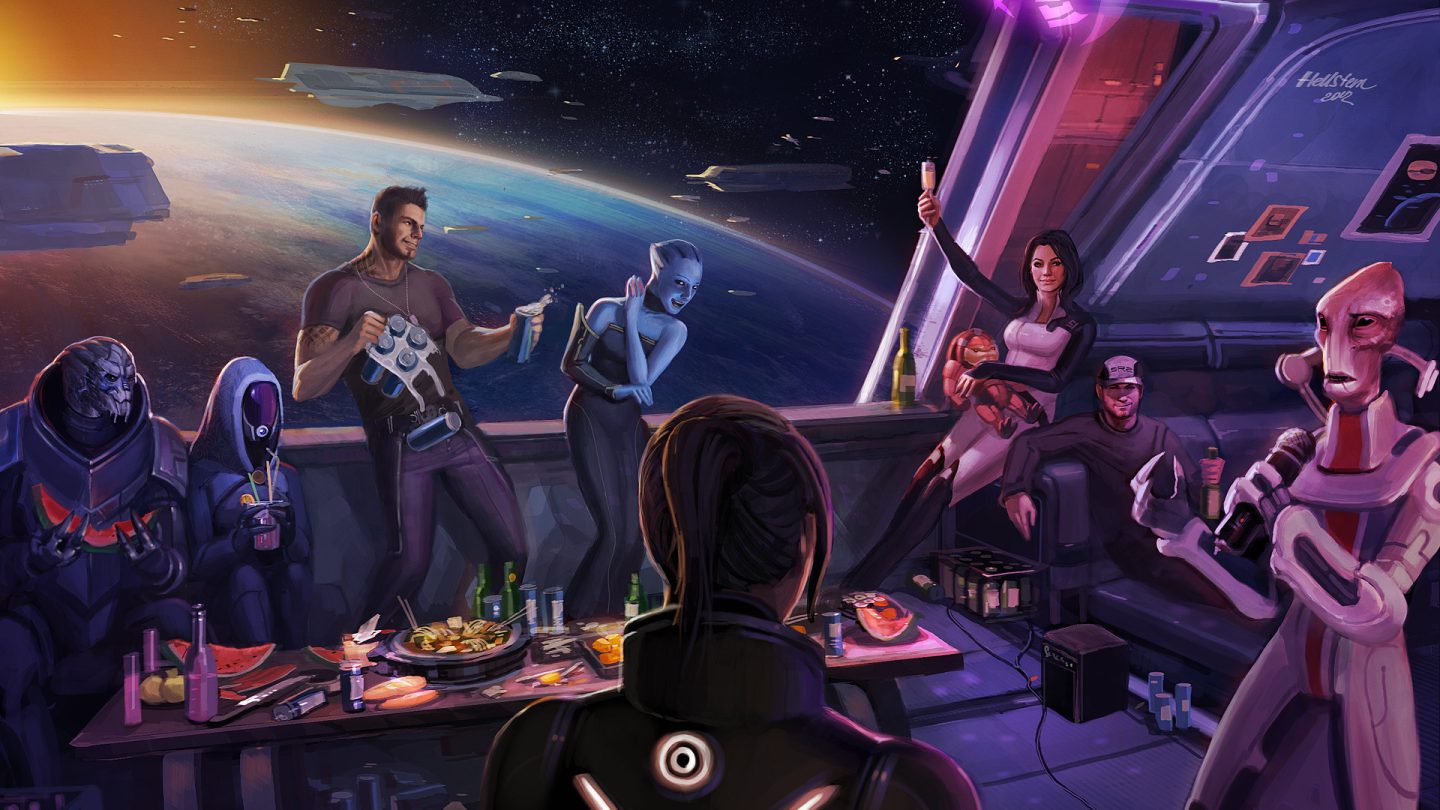
The desire for a happy ending comes from people not wanting to see the characters they love suffer. Image is “Mass Effect 3: How it Should’ve Ended” by DeviantArt user Hellstern
The desire for a happy ending comes from people not wanting to see the characters they love suffer. Image is “Mass Effect 3: How it Should’ve Ended” by DeviantArt user Hellstern Credit: Hellstern
But take heart, as Shepard himself says near the end of the series. Even if Shepard must be a hollow man for the sake of the player, the ease with which the player can fill his shoes means that Bioware made the correct set of design decisions.
I didn’t feel quite so maudlin about the series until the Citadel DLC came out, but now, it’s like I know all these aliens. They’re real, hanging out in the back of my head. We are Commander Shepard, and the crew members of the Normandy are our friends. Garrus. Tali. Liara. Thane. EDI. Joker. Jack. Wrex. Grunt. All the rest.
The ending of the series is this: Commander Shepard, surrounded by his team, ready to board the Normandy and set sail back out onto the ocean of night. That’s where they’ll always be.
Shepard’s squadmates are right: we’ve had a good ride.

Lee is the Senior Technology Editor, and oversees story development for the gadget, culture, IT, and video sections of Ars Technica. A long-time member of the Ars OpenForum with an extensive background in enterprise storage and security, he lives in Houston.